What SEO Writing Actually Means in 2025
Google now rewards sites cited in AI Overviews, not just those ranked highest.

Sixty percent of Google searches now end without a click to any website. The SERP itself has become the destination, which sounds abstract until you're the one watching your traffic reports.
This is not a uniform loss across publishers. It is a redistribution, and the losses are genuinely uneven. The median publisher saw a 10% year-over-year traffic decline in the first half of 2025. Non-news content sites fared worse, down 14% as a category. Some individual cases are severe enough to feel almost punitive: Digital Trends lost 97% of its search traffic, ZDNet 90%, NerdWallet 73%. These aren't anomalies you can dismiss. They are the logical endpoint of a system that no longer needs to send users somewhere else to deliver an answer.
What makes the picture messier is that even queries without AI Overviews saw a 41% year-over-year drop in organic click-through rate. The behavior shift is happening independently of any specific AI feature. People have simply learned to read the SERP differently, and that learning compounds. Gartner projects a 25% decline in traditional search volume by 2026.
Here is the reframe that actually changes how you work: zero-click is not attention disappearing. It is attention concentrating. A smaller pool of sources earns the citations and the featured placements, and that pool receives disproportionately more of whatever traffic remains. The strategic question is not how to reverse this. It is how to be on the receiving end of the concentration.
How AI Overviews and Google AI Mode Are Reshaping What Gets Cited, Not Just Ranked
AI Overviews appeared on 13.14% of all queries in March 2025, up from 6.49% in January. By November 2025, that figure had reached 27.43%, nearly sevenfold growth in ten months, according to Semrush's study of more than 10 million keywords.
The click-through rate damage is measurable and accelerating faster than most people anticipated. Ahrefs found that AI Overviews reduced CTR for the first organic position by 34.5% in April 2025. By December 2025, that figure had worsened to 58%. Google AI Mode, launched mid-2025, goes further still: 93% of AI Mode sessions end without visiting an external website.
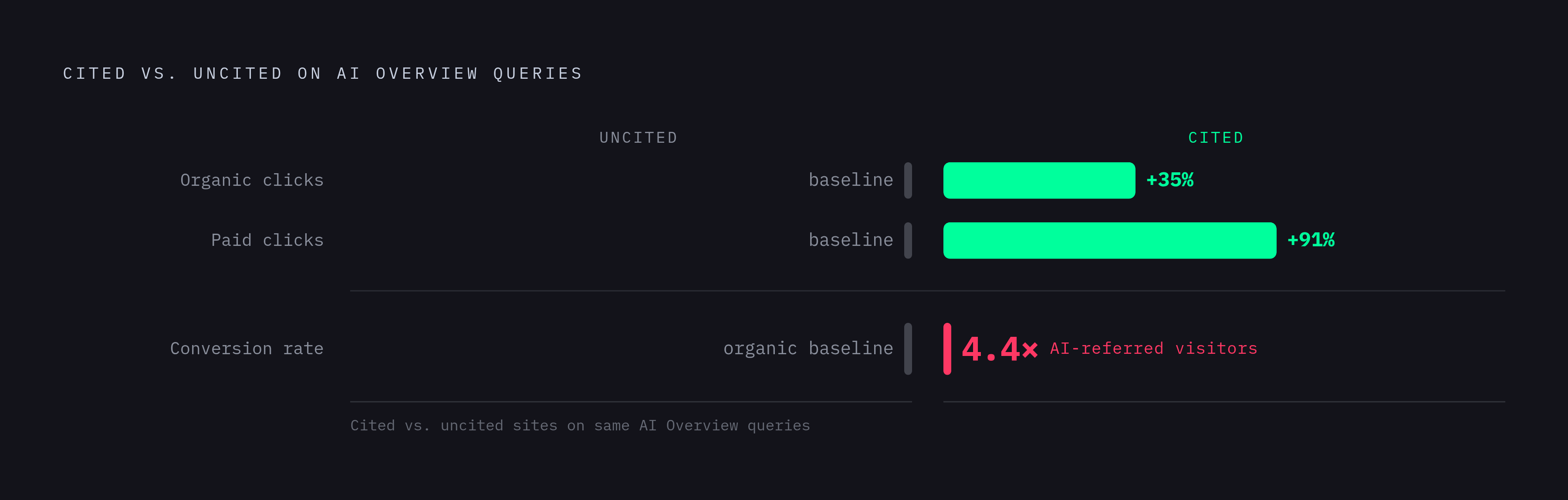
Two realities are operating simultaneously here, and most coverage collapses them into one. Sites not cited in AI Overviews lose clicks with no compensating benefit. Sites that are cited earn 35% more organic clicks and 91% more paid clicks than uncited competitors on the same queries. AI-referred visitors convert at 4.4 times the rate of traditional organic visitors, per Semrush's June 2025 data.
The mechanism that produces citation is genuinely different from the mechanism that produces ranking, and I think this is where a lot of writers are still confused. Citation requires that your content is structured, credible, and extractable enough for an AI system to pull a specific answer and attribute it to you with confidence. Think of it less like ranking and more like being quoted. The AI is looking for a source it can name. That is a different brief than optimizing for position one.
What Google's 2025 Algorithm Updates Actually Rewarded, Past the Noise
Three core updates ran in 2025, in March, June, and December, plus an August spam update. Read through all the coverage and a consistent thread emerges: Google was not penalizing content volume. It was penalizing low value per click. The December 2025 Core Update represented a deepening integration of quality evaluation into Google's core systems — not a new ruleset, but a more sophisticated and harder-to-game application of the existing one.
Google now compares pages against each other on the same query rather than against fixed criteria. A 3,000-word article that says nothing a reader couldn't find in thirty seconds elsewhere is not rewarded just because it reads as comprehensive. Length is not a proxy for depth. The system has gotten better at distinguishing between them.
Technical signals compound content quality in ways that concern any writer who publishes on a site they don't fully control. Sites with page load times above three seconds experienced 23% more traffic loss than faster competitors with comparable content quality, per ALM Corp's analysis. Behavioral signals, including bounce rate, dwell time, and return visits, carried increased weight in the December 2025 update. A well-written article on a slow, cluttered page can now lose to a leaner page with solid writing. The content and the experience are evaluated together, which means the writer's job extends further into the product than it used to.
Google's repeated language across these updates is worth taking literally: "better surface relevant, satisfying content." Satisfying, not relevant. Relevance is table stakes. Satisfaction is the actual standard, and it is evaluated through behavior, not just content.
What E-E-A-T Actually Demands from Writers, in Practice
E-E-A-T, which stands for Experience, Expertise, Authoritativeness, and Trustworthiness, is not a checklist of ranking factors. It is the evaluative lens Google's quality systems apply when determining whether a page deserves visibility. Treating it as a checklist produces exactly the kind of surface compliance that doesn't move the needle, which is worth saying plainly because most E-E-A-T guidance online treats it as exactly that.
Experience is the newest and most practically demanding component. Google expects actual use for product reviews and experience-led content — firsthand case studies, original data, specific personal observations. Not paraphrased summaries of what other sources already said. If you haven't done the thing you're writing about, that absence surfaces in the prose, and the quality systems have gotten better at detecting it.
Expertise must be surfaced on the page, not assumed to be understood. A financial article written by a certified financial planner with visible credentials, a detailed author byline, a photo, and links to relevant professional history sends a materially different signal than the same information published anonymously. Citing and linking to reliable external sources reinforces that signal. These are not bureaucratic formalities; they are how credibility is communicated to systems that cannot know who you are unless you tell them.
YMYL categories, covering finance, medical, and legal topics, face the strictest scrutiny. AI-only outputs in these areas carry the highest risk of quality penalties, because the stakes of misinformation are high and Google's quality raters are specifically trained to apply rigor there.
The underlying logic is uncomfortable but clarifying: in an environment saturated with AI-generated content, demonstrable human expertise and authentic experience are what separate a citable source from a commodity one. Not a philosophical position. A competitive reality.
Where AI Writing Tools Fit, and Where They Fall Short
Adoption is near-universal at this point. 86% of SEO professionals have integrated AI tools into their workflow as of SeoClarity's 2025 report. Google's official position is that quality determines rankings regardless of whether content is AI-generated or human-written.
The performance data is more nuanced than the policy statement. Ahrefs research shows pages at the top position have lower AI content proportions, particularly in the lower range of AI usage. HubSpot's 2024 Web Strategy Survey found that 46% of marketers said AI-assisted content ranked higher, down from 65% the year before. The advantage is narrowing as AI output becomes table stakes rather than a differentiator.
Where AI-only content structurally fails is worth being direct about, partly because it gets papered over in most AI content discussions. Models trained on existing content produce content that resembles existing content. Google evaluates uniqueness as a quality signal. A model cannot have used a product, visited a place, or made a professional judgment call in a specific client situation. The signals Google now weights most heavily cannot be generated by a model because they are signals of actual human experience. Reader frustration with AI content isn't usually about grammar or factual errors. It is about the absence of a perspective that costs something to hold.
The practical model that works: AI handles research synthesis, structural scaffolding, and first-draft velocity. Human editorial judgment supplies the original experience, the real perspective, and the credibility signals that earn citation. The failure mode isn't using AI. It is using AI to replace editorial thinking rather than to accelerate it.
How Topical Authority Changes the Unit of SEO Work from Posts to Ecosystems
Keyword matching is no longer the primary lever. Search engines now evaluate how thoroughly a site covers a subject, not whether a single page contains a target phrase. That shift changes the fundamental unit of SEO work from an individual article to a content ecosystem, and most editorial workflows haven't caught up to it.
The topic cluster model is the operational response. A central pillar page covers a broad topic comprehensively. Cluster articles cover specific subtopics in depth and link back to the pillar. The structure tells search engines that the site is a genuine resource, not a one-off publisher who happened to write about something once. Google now indexes individual content passages, not just pages, so well-structured subheadings and paragraphs can rank independently and capture multiple search intents within a single piece.
Update frequency matters in this model more than people acknowledge. Fresh content signals ongoing relevance in ways a static archive does not. Entity authority extends the principle further: consistent presence and citation across digital channels, not just your own site, reinforces topical signals. Being the source others cite is part of the signal, which creates a productive if slightly recursive incentive to actually be authoritative rather than just appear to be.
The practical implication: every piece of content should be written with explicit awareness of where it sits in a larger topic map. What does the pillar page cover? What does this specific piece cover that the pillar doesn't? How do they connect? A standalone optimization exercise is no longer the job. The job is building a node in a network, and a node that doesn't know what network it belongs to doesn't reinforce anything.
How GEO Differs from SEO, and What Writers Actually Need to Do Differently
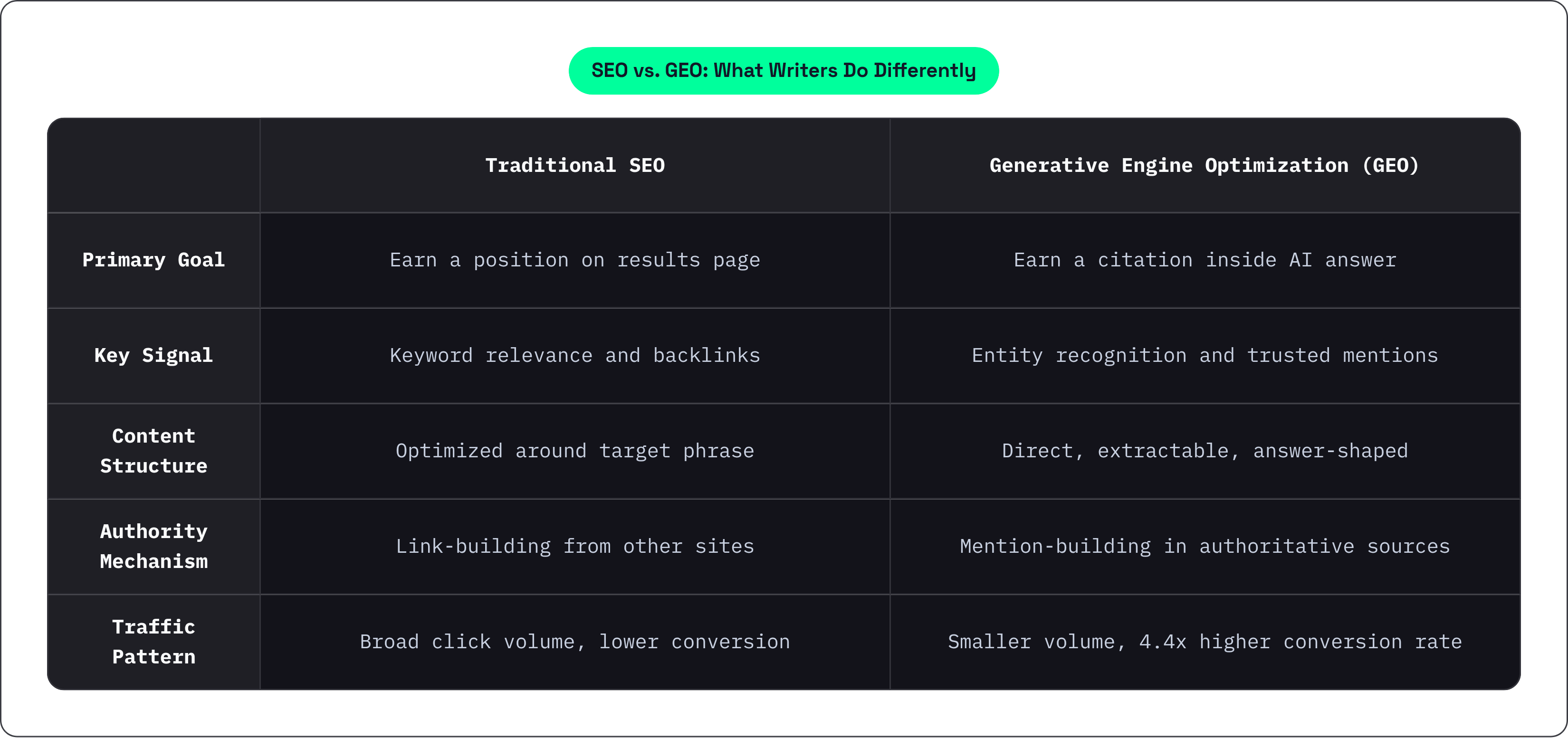
Generative Engine Optimization, GEO, means optimizing content to be cited inside AI-generated answers on platforms like ChatGPT, Claude, Gemini, and Perplexity. Traditional SEO earns a position on a results page. GEO earns a position inside the answer. These are meaningfully different outcomes with meaningfully different requirements, and conflating them produces strategies that half-work for both.
GEO places more emphasis on entity recognition than keyword density. Large language models understand concepts and named entities rather than matching phrases, so writing that clearly establishes what something is, who it involves, and why it matters in explicit terms performs better in AI retrieval than writing engineered around a target phrase. Mention-building matters more than link-building in this context: trusted mentions of your brand or content in authoritative sources influence LLM training and retrieval in ways that backlinks do not. Answer-shaped content structure is also critical, direct and extractable, with enough context that an AI system can quote it without distorting it.
Both SEO and GEO depend on clarity, demonstrated authority, and content that genuinely addresses user intent. The underlying requirements are not in conflict.
One context check worth keeping: AI chatbots represent a small fraction of overall search traffic currently. Writers and strategists should optimize for both channels rather than pivoting entirely toward GEO. The writer who understands both can execute strategy that most competitors are still treating as separate problems.
What SEO Writing Now Requires at the Level of a Single Piece
The question at the start of any piece is no longer "what keyword am I targeting?" It is "what question am I answering, for whom, and what would make this the most credible and complete answer available?" That reorientation sounds incremental. Its practical implications are not.
Structure content for extraction. Clear subheadings, direct answers near the top of sections, defined terms — these are what AI systems and featured snippets pull from. If your most useful answer is buried in paragraph seven of a flowing narrative, it is harder to surface than if it appears immediately after a subheading that names the question. This doesn't mean abandoning good prose. It means being deliberate about where the payoff lives.
Demonstrate experience on the page. First-person observations, original data, named examples, stated credentials: these are not optional flourishes. An AI system choosing between two sources of similar factual content will preferentially cite the one with clear attribution and verifiable expertise. The content that looks like it came from somewhere real is what gets quoted.
Serve the page experience alongside the content. The December 2025 update confirmed that behavioral signals and technical performance are evaluated in tandem with content quality. Slow loads, cluttered ad placements, poor mobile responsiveness: these erode the impact of good writing, and the writer's job now includes advocating for the conditions under which the writing will be read.
Write with explicit awareness of where the piece sits in a larger topic architecture. Know what the pillar covers, what this piece covers specifically, how they connect, and where the internal links should go. A piece that doesn't know where it lives in the larger structure misses the cumulative authority signals that build over time.
Revisit and update. Freshness is a ranking variable, and a piece that performed well eighteen months ago will need substantial revision to hold its position or its citation presence. Content is not a one-time asset in this environment. It is something you maintain, the way a relationship requires maintenance, not just a good first impression.