Scaling Content Production from 4 to 20 Posts Per Month
Twenty posts monthly beats four because you need a system, not just more writers.

Scaling content from 4 posts a month to 20 breaks teams for one reason: they treat it like a bigger version of the same job instead of a different job entirely. The ones who actually hit 20 reliably built a system first, strategy, templates, a real split between people and tools, and only then let the calendar fill up. I've run this math badly, on a team that thought hiring one more writer would fix everything, and I've watched it done well. What follows is the difference between those two outcomes, including the HubSpot wreck that's become a campfire story in every SEO Slack channel I'm in.
What the traffic data actually says about the right target frequency
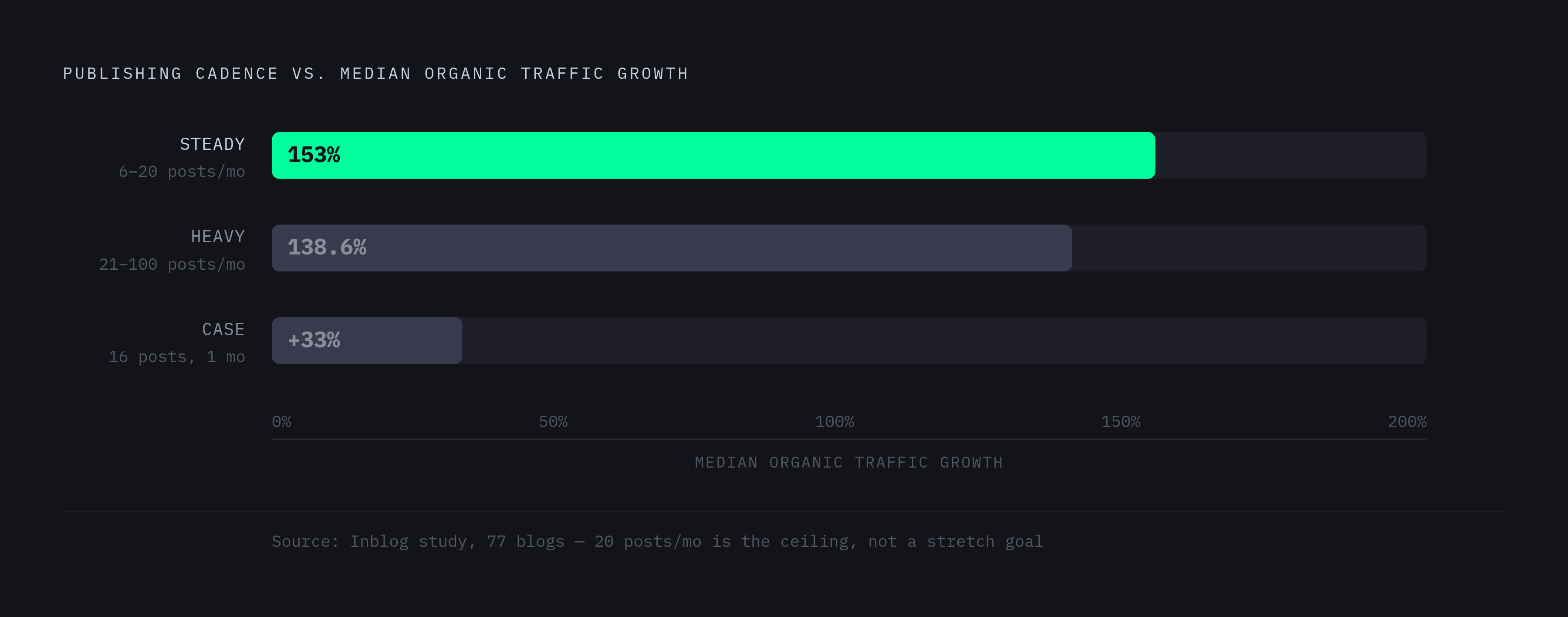
More isn't automatically better. Inblog looked at 77 blogs and found that a "steady" cadence, 6 to 20 posts a month, produced median organic growth of 153%. The "heavy" tier, 21 to 100 posts monthly, only hit 138.6%. Twenty sits right at the top edge of the range where the payoff still works; past that, you're paying more and getting less back for it.
One B2B blog published 16 posts in a single month and saw daily visits jump 33% almost immediately. But the bigger gains showed up months later, in Q3 and Q4, once those same posts had time to climb the rankings. A publishing decision made in January might not show its full value until August, and try explaining that lag to a finance person asking about ROI in March.
Frequency isn't a blank check either. Google's Search Advocate John Mueller has said more than once that forcing frequency produces mediocre, fluffy content, the kind that actively hurts rankings. Twenty posts a month works, and the Inblog numbers back that up, but only when every post earns its slot. What does "earning its slot" mean when you're the one staring at a half-empty content calendar on a Tuesday afternoon? That question is basically the spine of everything below.
Why HubSpot's traffic collapse is the cautionary case every scaling team should study
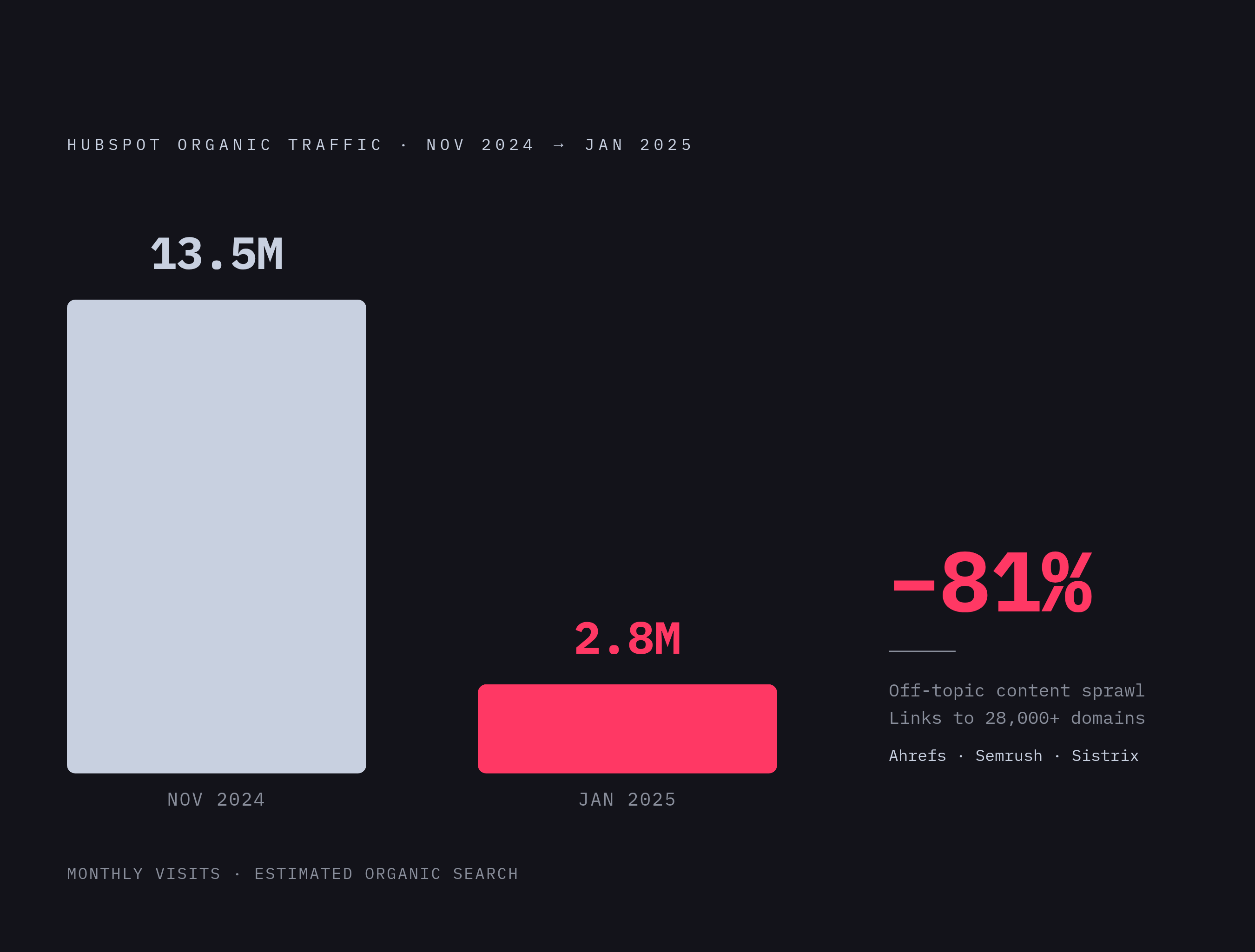
Sit with this number: between November 2024 and January 2025, HubSpot's organic traffic fell from 13.5 million monthly visits to 2.8 million. That's an 81% drop, confirmed independently by Ahrefs, Semrush, and Sistrix, so it wasn't some dashboard glitch or a one-source fluke.
What caused it was the shape of the content itself. Famous-quotes roundups. Shrug-emoji explainers. Resignation letter templates. Posts that had drifted so far from marketing or sales expertise that nobody reading them would guess what the company actually sells. Their blog also linked out to more than 28,000 external domains, scattering whatever authority it had across the internet instead of building it anywhere.
Google's Helpful Content system punishes that kind of sprawl as hard as it punishes bad writing. A site covering everything under the sun reads as an expert in nothing, no matter how clean the sentences are. It's the same instinct that makes a resume listing "expert in everything" impressive for about four seconds and suspicious the moment anyone reads the second line.
Volume without a topical center is how a content operation turns into a liability without anyone noticing until the traffic graph falls off a cliff. So what keeps that from happening at 20 posts a month, without spending six weeks building a framework before writing a single word?
How a pillar-cluster architecture turns 20 posts per month into a coherent topical signal
Twenty interconnected articles on one subject tend to beat a single 5,000-word guide trying to cover the same ground alone, because Google's Helpful Content system is explicitly rewarding depth and breadth together. That's the logic behind pillar-cluster content, and it maps onto a 20-post monthly target almost too neatly, which makes me wonder if the format was reverse-engineered from this exact problem in the first place.
The shape is simple enough to sketch on a napkin. One pillar page, somewhere in the range of a few thousand words, covers a core topic fully and links out to a set of satellite articles that each go narrow and deep on one piece of it. A typical pillar supports a set of satellite articles, which means a team publishing 20 posts a month can focus on a manageable number of active clusters at a time. That's a far easier thing to hold in your head than "20 unrelated ideas due by Friday."
And the payoff compounds. Clustered content drives over 30% more organic traffic than standalone posts and holds its rankings roughly 2.5 times longer. Sites that keep the structure running for 12 months or more see traffic run about 40% higher than teams stuck on single-page strategies. There's a newer wrinkle too: a Yext AI Citation Study found topic clusters get cited by AI systems 3.2 times more often than standalone posts, which matters a lot more now that AI Overviews eat up so much real estate on the results page.
None of that works if the cluster map gets built after the fact. Before anyone drafts a word, the team needs topics, subtopics, and internal linking logic mapped out, not a calendar with 20 blank boxes waiting for whatever feels timely that week.
The real production math that makes 4 to 20 posts feel impossible without a system
Here's the arithmetic that usually gets skipped before someone commits to "20 posts a month" in a planning meeting. Orbit Media's 2024 Annual Blogger Survey clocked average time per post at 3 hours and 48 minutes. Round it to 3.5 for clean math, and jumping from 4 posts to 20 adds roughly 56 person-hours of writing a month, before editing, SEO review, or design touches any of it.
Length isn't holding still while this happens, either. Average post length reached 1,427 words in 2026, while the 2025 average stood at 1,333 words. Posts over a certain length threshold earn 77% more backlinks than shorter ones, so length isn't padding; it's doing real work in how a piece gets cited and linked elsewhere.
The obvious fix, throw more writers at the gap, runs into money fast. Experienced freelancers run $200 to $600 per post, so 20 posts a month at the floor price alone lands around $4,000, before anyone edits or designs a thing. A full-time in-house writer costs a median salary near $69,000, or $86,000 to $97,000 loaded with benefits and overhead. One hire doesn't close a 16-post gap between where a team is and where it needs to be. It barely dents it.
If headcount can't solve this on its own, and the math above is pretty unforgiving on that point, the only lever left is making each hour of production stretch further. That's not a hiring question. It's a workflow question, and it's the whole subject of the next section.
What a repeatable content workflow actually looks like at 20 posts per month
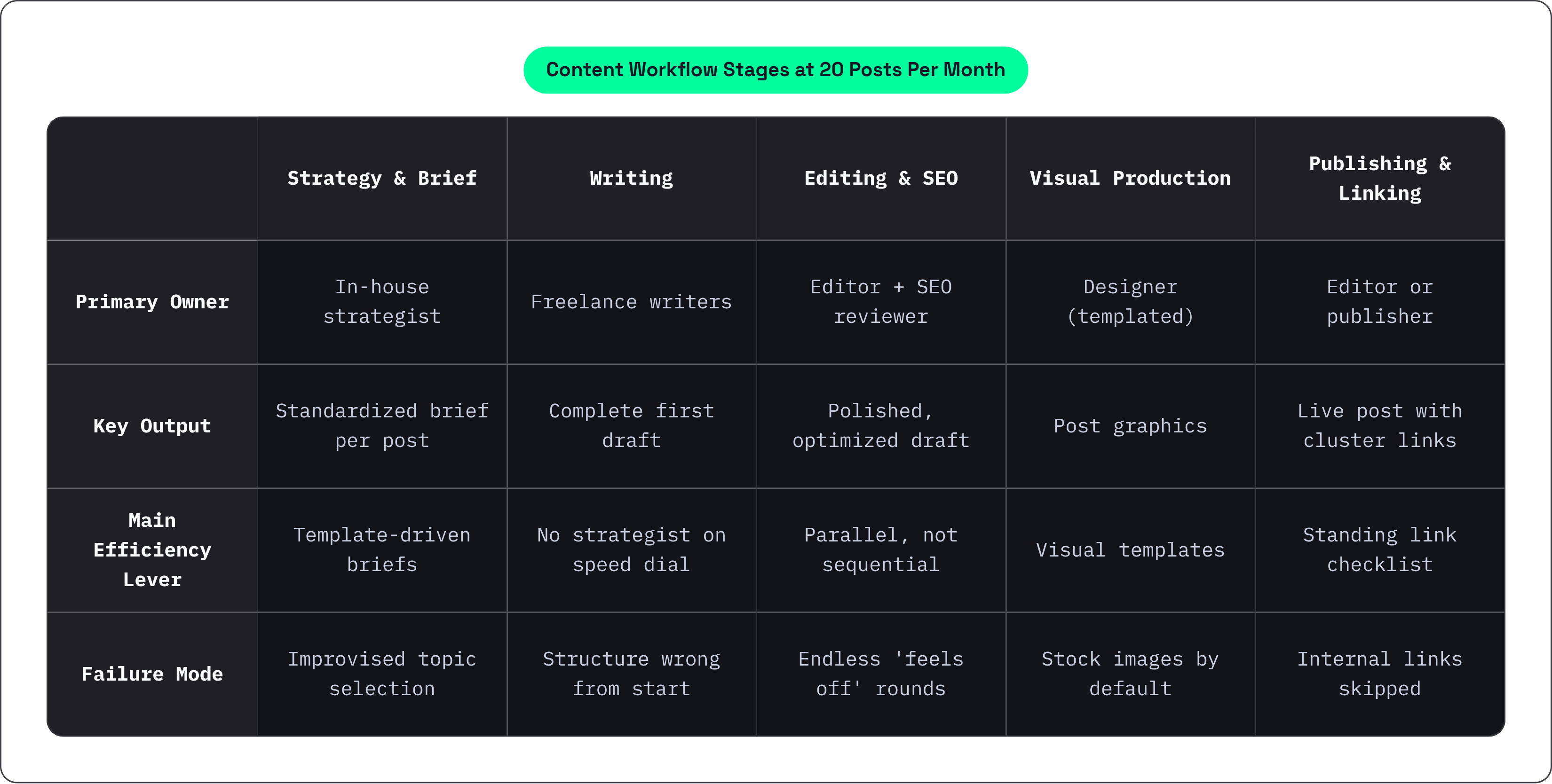
At 4 posts a month, informal coordination works fine. Someone has an idea, someone writes it, someone glances at it before it goes live, everyone moves on with their week. At 20, every one of those informal handoffs has to become a documented step, or it quietly caps output at 12 no matter what the calendar promised leadership.
Strategy and brief creation comes first, and it needs to absorb all the thinking up front so nobody's improvising later. Each post starts with a brief covering the target keyword, search intent, its spot in the cluster, an outline, the key claims, and which internal links it owes. A good brief kills the back-and-forth between strategist and writer, which I've watched eat more hours than actual writing on more than one team. Once a strategist has a working template, 20 briefs take a fraction of the time it'd cost to brief 20 people separately, one conversation at a time.
Writing comes next, kept cleanly apart from editing. Writers work off the brief without a strategist on speed dial; questions go into a shared doc instead of a Slack thread that splinters into six side conversations nobody can trace back later. A first draft's job is to be complete, not pretty. Editors exist to fix voice and quality, not to discover three drafts deep that the structure was wrong from the start.
Editing and SEO review run in parallel, not sequentially. Nothing stops an editorial pass and an SEO check from happening on different sections of the same draft at the same time, and a style guide with a checklist replaces what would otherwise be endless rounds of "it just feels off to me."
Visual production deserves its own line and usually doesn't get one. Stratabeat's 2025 data found custom graphics correlated with a 44.7% jump in organic traffic, while stock images correlated with a 2.6% decline. Visual templates let a designer produce post graphics in a fraction of the time custom work from scratch would take.
Publishing and internal linking close the loop, and this step isn't a nice-to-have; it's literally how the cluster architecture generates its authority signal. A standing checklist of which posts link to which pillar pages takes the decision out of the writer's hands entirely, so it isn't a fresh judgment call made 20 times a month by 20 different people with 20 different opinions.
Every one of those five stages runs on the same idea: a decision made once, baked into a template or checklist, never needs re-litigating.
How to divide the work between in-house roles, freelancers, and AI tools
There's a specific point where pure freelancer management stops working, and it's worth naming exactly where. At 4 posts a month freelancers working from tight briefs are completely manageable. As volume climbs toward 16 and beyond, the freelancer-only model strains quickly; someone's either managing a full roster as an actual job, or the team is running on a system built for this volume from the start.
The hybrid setup most high-output teams land on has a pretty consistent shape. An in-house strategist or editor owns the cluster map, writes the briefs, protects brand voice, and acts as the last gate before anything ships. Freelance writers handle volume, working strictly off those standardized briefs, which is exactly what makes them useful here instead of a liability waiting to surface. Specialists come in as needed: an SEO reviewer, a designer, a subject matter expert when technical accuracy has real teeth.
Where do AI tools actually earn their keep? Brief generation. Outline drafting. Speeding up first drafts. SEO metadata, internal link suggestions. That's the honest list, and it stops there. AI speeds up production without understanding strategy, so mistaking the tool for the strategy layer is how a team ends up with a HubSpot-shaped problem faster than anyone expects. According to Semrush, 44% of content marketers reported success from publishing more often, and the teams behind that number are running AI-assisted workflows alongside real human editorial oversight, not instead of it.
Platforms built around that exact split, AI-assisted drafting paired with human editing, let marketing teams keep ownership of strategy without rebuilding an agency in-house from scratch. One thing worth carrying forward: communication overhead scales nonlinearly as a team grows. Add people without documented workflows, and mostly what gets added is meetings, not output.
The quality floor a scaled operation has to hold to avoid the volume trap
Volume has its own gravity, and that gravity bends toward approving things faster once the calendar fills up and Friday's closing in. That's exactly how thin content piles up: a dozen small, reasonable-sounding shortcuts, none of them flagged at the time they were made.
Two formats punch well above their word count and are worth building a program around. Original research gets published by nearly half of content programs, and a quarter of those report strong results from it; one original data piece a quarter raises the authority ceiling for an entire cluster, not just the post carrying it. Long-form cluster content keeps that 77% backlink edge for posts over 1,890 words, and unlike most SEO tactics, that edge compounds as the cluster ages instead of fading.
There's also an update problem that gets ignored in the rush to keep publishing new material. Some analysts recommend putting at least 50% of content effort into refreshing existing articles rather than only chasing net-new posts. At 20 a month, that means a real chunk of those slots should go to structured updates of older posts with untapped potential, giving old material a second life instead of just filling another blank box on the calendar.
A working quality gate checks a short list of things, no exceptions. Does the post actually answer the subtopic its cluster brief assigned, or did it wander somewhere else along the way? Does it make a specific, defensible claim, or does it settle for general advice dressed up as insight? Is the visual standard enforced through a template, or is it getting negotiated fresh on every post like nobody's ever thought about it before?
Teams that hold 20 posts a month without the quality slipping have built a system where that check happens automatically, wired into the workflow itself, instead of depending on someone catching the problem heroically at 11pm the night before it ships.