In-House Content Team vs Content Agency Comparison
The fully-loaded cost math favors in-house teams over time, but agencies win on speed.

An in-house content team is a payroll line. Writers, strategists, editors, sometimes a designer or a video person, all employed by the company, all reporting up through marketing leadership. They know the product because they use the internal wiki, sit in the same Slack channels as sales, and have probably been yelled at by the same VP at least once. A content agency is an outside firm you hire on retainer, project, or hourly basis, bringing its own staff, its own tools, its own process. The relationship is contractual, not employment-based, and that distinction matters more than it sounds like it should.
There's a third option, freelancers, worth naming here even though it doesn't get its own section until we talk about hybrid models later. For now, park it.
Neither in-house nor agency is one thing. In-house can mean a single marketing generalist who writes blog posts between other duties, or it can mean a dozen people with dedicated SEO, social, video, and strategy functions, each with their own KPIs. Agencies range the same way: boutique studios with four people and a Notion board, up through full-service growth firms with account managers, strategists, and a production pipeline that would make a magazine editor jealous. What a retainer actually buys you varies enormously depending on the firm and the fee, which is exactly why comparing "an agency" to "an in-house team" without specifying scope is a little like comparing a food truck to a restaurant chain. The comparison only means something once both sides are sized to the same job.
How the true cost of each model looks once everything is counted
Here's where most budget conversations go sideways: the salary line looks like the cost, but it's really just the cover charge.
Add recruiting fees, benefits, onboarding time, software licenses, and the management hours it takes to actually run a person, and the fully-loaded cost of one senior content hire runs meaningfully above whatever number was on the job posting. Multiply that by three or four people, and you've got a team whose total annual cost tends to surprise finance departments that were only looking at the individual salary rows. Nobody budgets for the invisible stuff until it shows up on the invoice, which in this case is the payroll system.
Agencies flip the sticker shock in the other direction. A monthly retainer looks big when you first see it, but it's buying you a team of specialists with zero recruiting cost, zero benefits burden, and a first deliverable that shows up in weeks instead of months. Hourly and project-based pricing exist too, mostly for companies testing the waters before committing to a retainer; useful if you're not sure you want the whole meal yet.
So which one's actually cheaper? Depends entirely on your time horizon. In the early months, agencies almost always win on cost per piece, because your in-house hire is still figuring out where the style guide lives. Stretch the window out to roughly a year and a half or two years, and an experienced in-house team, with all that accumulated institutional knowledge, starts closing the gap or reversing it outright. Push the volume high enough and sustain it long enough, and in-house production economics tend to become the better deal, mostly because agency retainers don't get cheaper as your volume grows. They scale with you, not against you.
One cost that didn't exist in this conversation a few years ago: AI tool subscriptions. That line item has grown fast, and any in-house team building a modern content operation now has to budget for it right alongside salaries. It's not a rounding error anymore.
The useful frame here is cost per asset, tracked against time and volume, rather than total annual spend. Everything else is noise.
Speed from decision to first published content
Hiring is slow. Not a controversial statement, but it's easy to forget just how slow until you're the one waiting. Job posting, screening, interviews, an offer, a notice period, onboarding, ramp-up: a single senior marketing hire realistically takes several months to go from open req to genuinely useful output. Now multiply that by three or five people, because you're not hiring one person, you're building a team, and that math doesn't scale linearly. A fully functional in-house content operation, built from nothing, can take over a year to stand up.
An agency can have a first asset in your inbox within weeks of a signed contract, with an already-trained team, already-configured tools, and other clients already being served on the same afternoon they onboard yours.
This isn't just a nice-to-have. Speed has teeth. A product launch doesn't pause for your onboarding schedule. A competitive gap in search results doesn't wait for your new hire to finish week six of ramp-up. For companies in categories that move fast, that ramp period is a real, measurable business risk, the kind that shows up in a competitor's search rankings before it shows up in your postmortem deck.
Speed is where the agency model makes its strongest case, right out of the gate. But it's not the whole story, and the next section is where that story gets complicated.
Brand voice and subject-matter depth — where in-house holds a structural advantage
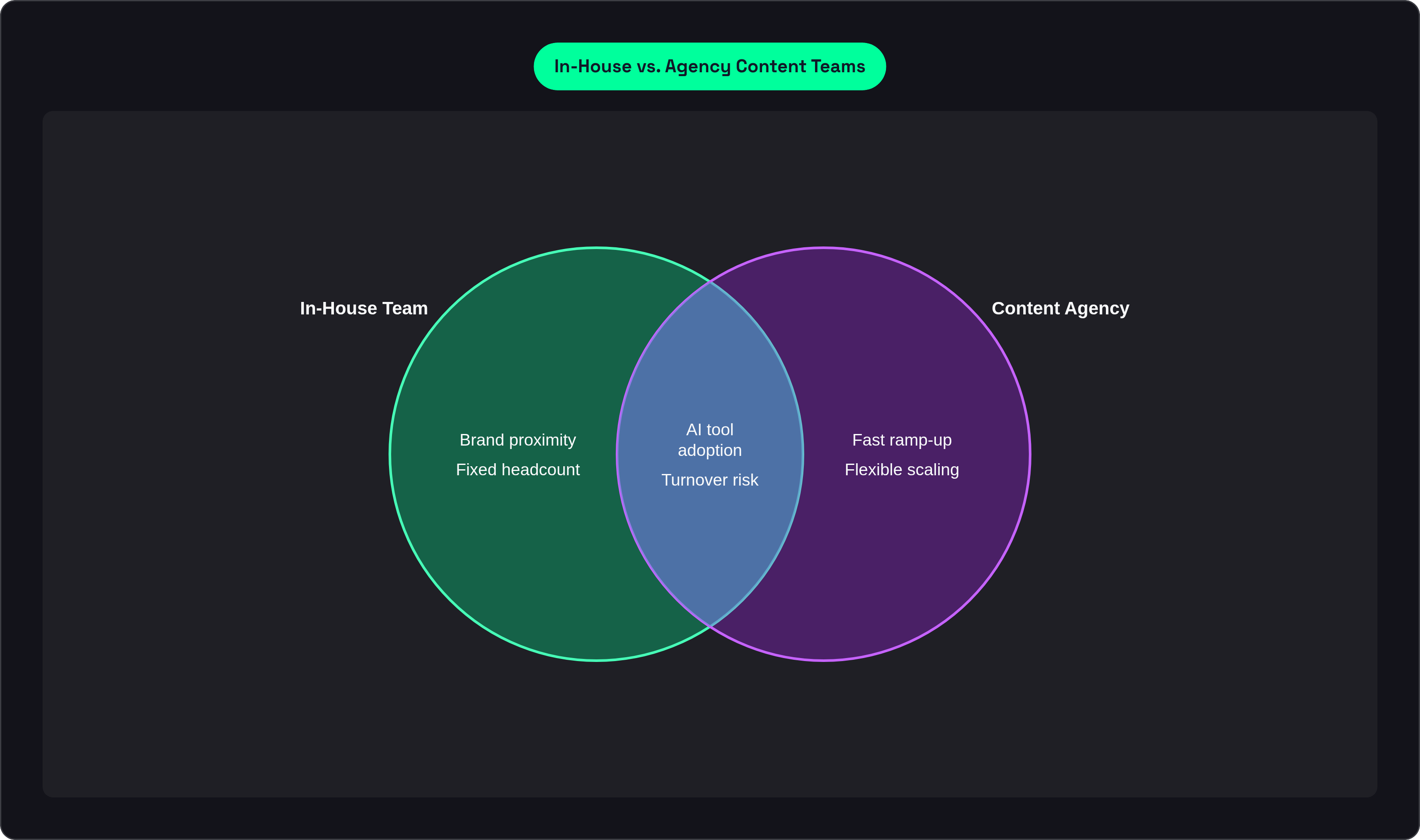
In-house teams build up something agencies can't easily buy on a retainer: proximity. They sit near product, hear sales calls, and catch the offhand comment from leadership in a hallway (or, more realistically, a Slack thread) that ends up shaping how a whole campaign gets framed. A style guide is what you write down after the fact to describe decisions that were already made by people who've spent years absorbing the company's history, its audience, and its competitive scars.
This connects to something that shows up a lot in B2B marketing: most companies say they want to produce genuinely expert-level content, thought leadership that actually reflects deep knowledge. But a lot of that content gets produced without much involvement from the people inside the company who hold that expertise in the first place. The engineer who understands the product at a level nobody else does rarely gets asked to sit in on the content review. An in-house team, sitting closer to that expertise by default, has a real structural edge in closing that gap.
Agency brand-voice risk is largely a workflow problem, not a talent problem. Agencies that invest in real briefing documents, review cycles, and feedback loops can hit brand voice consistently. Agencies that treat a PDF style guide as a sufficient handoff tend to produce content that reads exactly like what it is: written by someone outside the building. The quality of an agency's intake process matters more than its size or its logo wall of client testimonials.
Agencies also bring something in-house teams genuinely lack: exposure across industries, format specialization, and an outside perspective that can reframe a stale internal narrative. A strategist who's worked with a dozen SaaS companies has seen a dozen different ways to solve the same positioning problem, and that comparative benchmark is worth something real. A meaningful share of companies cite exactly this, access to specialized expertise, as their reason for hiring an agency in the first place. Depth favors in-house, range favors agencies, and which one matters more depends entirely on what the content is actually trying to do.
Scalability when content demand spikes or drops
In-house teams have a ceiling, and it's not a soft one. Want more output? Add headcount. Adding headcount means recruiting lag, fixed costs that don't go away when the campaign ends, and the very real risk of being overstaffed three months after the surge passes and everyone's just sort of looking around for something to do.
Demand doesn't arrive evenly. Product launches, seasonal pushes, a new channel bet, market entry: all of it creates lumpy demand, and a team sized for steady-state production is going to strain under a spike it didn't plan for.
Agencies absorb that lump more gracefully, because they're staffing across many clients simultaneously and can shift resources without you footing a hiring bill. The flexibility runs in both directions too: scaling down an agency relationship means adjusting a retainer. Scaling down an in-house team means layoffs, with all the human and reputational cost that entails. Nobody wants to be the marketing leader explaining a RIF that happened because the campaign ended.
Worth noting: if your content needs are genuinely steady, month over month, this whole scalability conversation matters a lot less. It's the high-growth, campaign-driven businesses where this flexibility premium actually earns its keep.
Control, transparency, and the risks that come with handing content to an outside team
In-house content lives where you can see it. Priorities get set internally, timelines get enforced internally, and if something's going sideways, leadership can walk over (physically or virtually) and course-correct before it ships. That visibility is worth something, even if it's hard to put a dollar figure on it.
Agency work is murkier by nature. Progress reporting depends entirely on that agency's own systems and communication habits, and those vary wildly from firm to firm. There's also a risk that doesn't get discussed enough: competing priorities. An agency serving twenty clients might, understandably, deprioritize your account during a busy stretch, and a retainer doesn't guarantee the attention its price tag implies. You're one voice in their client roster, not the only one.
Confidentiality adds another layer. Product roadmaps, unreleased research, customer data that feeds into strategy: all of it carries exposure risk the moment it leaves the building and lands in an external vendor's inbox. For some industries, that risk alone rules out certain agency relationships entirely.
And then there's turnover, which hits both models, just differently. Agency turnover has historically run high, so when the account manager who actually understands your brand leaves for a different firm, that institutional knowledge leaves with them. Their replacement often starts close to zero on brand understanding, which means you're re-briefing a stranger. In-house turnover cuts the other way: a competitor recruits your best content strategist, and now they're taking your audience insights, your positioning history, and your internal playbook with them to a rival's payroll. Replacing that person costs a lot relative to their salary, and that's before you count the six months it takes the replacement to get fully up to speed.
Neither model makes this risk disappear. They just make you manage it differently.
How AI is changing the economics and staffing of both models
AI adoption among marketers is close to universal at this point; not using any AI tool in your content workflow is now the outlier position. The conversation has shifted from "should we adopt this" to "how are we using it and is it working."
The productivity gains are real. Marketers using AI tools report getting meaningful hours back each week, and teams that have built AI into their workflow are publishing noticeably more content per month than teams that haven't. That's not a marginal difference.
For in-house teams, this changes the headcount math directly. A smaller team, running AI-assisted drafting, research, and editing workflows, can now produce volume that used to require more hands. But that gain isn't free: AI tool subscriptions have become a real budget line, one that's grown fast, and it has to sit next to salaries in any honest accounting of what an in-house team costs to run.
For agencies, the shift is structural rather than incremental. Per Gartner's CMO Spend Survey 2026, junior production roles have shrunk at many firms while demand for senior strategists has grown, and that shift is expected to continue. What a retainer buys you is changing underneath your feet: less raw production labor, more strategic direction. If you're evaluating an agency right now, ask them directly how AI has changed their delivery model. If they dodge the question, that tells you something too.
There's a third path worth naming: software platforms that pair AI-assisted production with actual editorial oversight, which can compress the cost and speed gap between in-house and agency for certain kinds of content. It's worth asking, before signing anything, whether you need a full agency relationship at all for some of what you're trying to produce.
The economics of both models look different than they did two years ago, and pretending otherwise is how budgets go stale.
The factors that actually determine which model fits a given situation
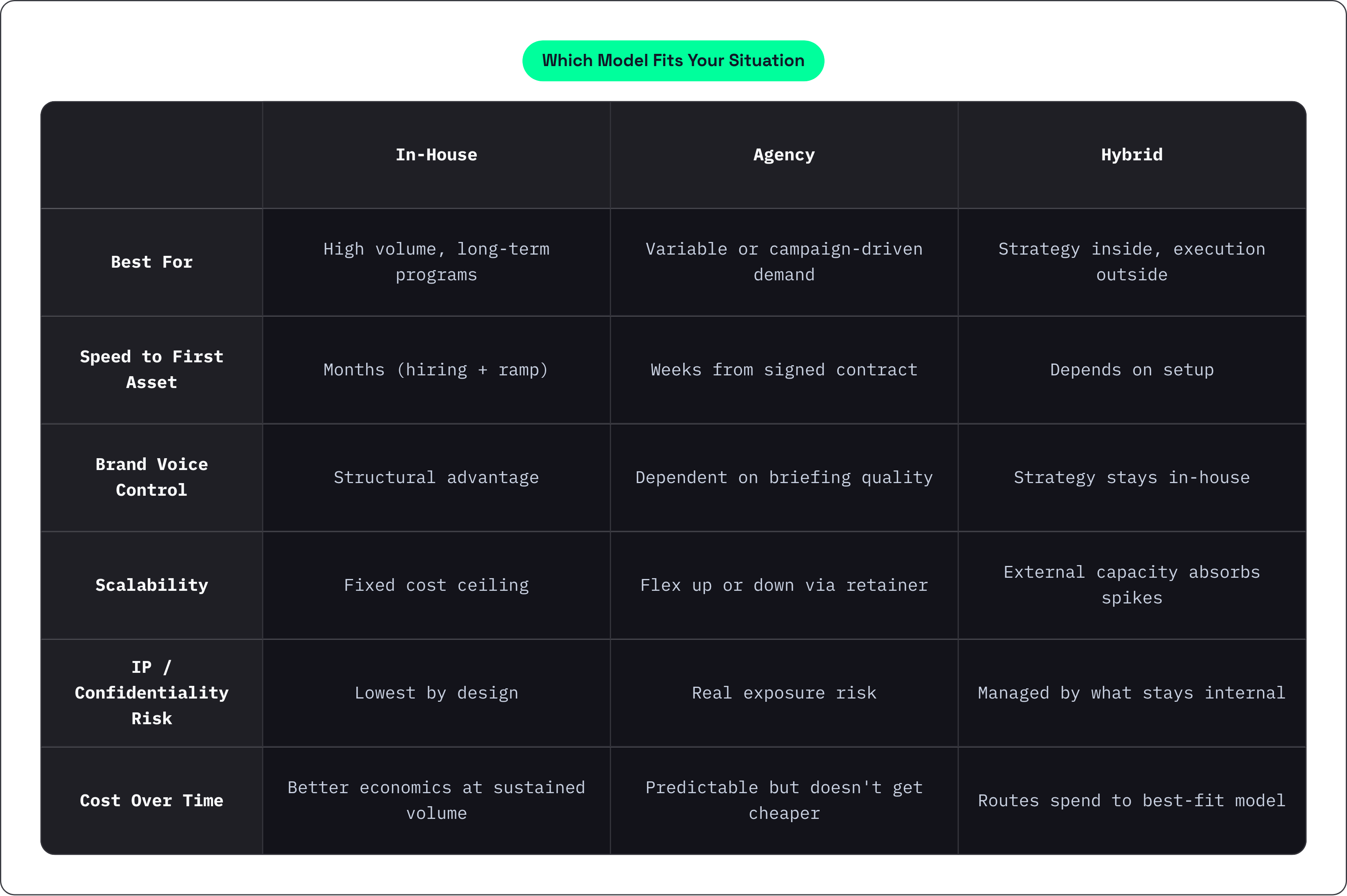
So how do you actually decide? A handful of factors do most of the work.
Company size and content volume matter, but not in the direction people assume. Smaller teams with variable, unpredictable content needs generally get more value from an agency's flexibility. Larger organizations with sustained high volume often find in-house more economical over the long run, but scale alone doesn't decide it: B2B companies with over a thousand employees still outsource most of their content marketing activity, which tells you that size doesn't automatically point toward building in-house.
Time horizon and urgency split cleanly. Need content in weeks, not months? Agency. Building a long-term brand asset and willing to absorb a ramp period to get compounding institutional knowledge? In-house is worth the wait.
Content complexity plays a role too. Highly technical products, regulated industries, a founder-led voice, content that depends on knowledge that only lives inside the building: in-house proximity is doing real work there. A broad content program where format range and channel diversity matter more than institutional depth tips the other way, toward agency specialization.
Budget structure and risk tolerance factor in as well. A fixed budget that needs predictable output is easier to model against an agency retainer. Willingness to absorb upfront hiring costs in exchange for long-run savings makes in-house viable, but only if the volume actually justifies it.
Demand predictability rounds it out. Steady, consistent output needs? Either model holds up fine. Spiky, campaign-driven, growth-stage demand? That's where agency or hybrid flexibility earns its premium. And if control and confidentiality carry real weight, if you're sensitive to IP exposure, pricing strategy, or roadmap leaks, in-house carries less exposure risk by design.
Why most mature content programs end up using both
Here's the thing nobody tells you at the start of this decision: you probably don't have to pick one. The market's moving toward hybrid, and the share of companies using both in-house and external resources together keeps growing.
The structure that keeps showing up in B2B and SaaS looks like this: an in-house strategist or content lead owns brand voice, strategy, and alignment with the business; an agency or platform handles SEO-driven production at scale; and freelancers fill the gaps, specialized formats, sudden volume surges, the stuff that doesn't fit neatly into either full-time headcount or a standing retainer.
It's a structure that deliberately routes each part of the work to whichever model is actually built for it. Internal ownership of strategy prevents the brand-voice drift that purely outsourced programs run into. External execution at scale prevents the bandwidth ceiling that purely in-house teams eventually slam into, usually right when they need output most.
Tools that combine AI-assisted production with real editorial oversight, strategy-first content platforms built around that workflow, can anchor this hybrid setup, giving an in-house lead leverage over external execution without giving up control of quality or voice. The hybrid model also handles turnover risk better than either pure model does, because strategy lives inside the company where it's protected, while execution capacity lives outside it, where it can flex. Neither side carries the whole weight alone, which, if you've made it this far, is probably the closest thing to a clean answer this topic is going to give you.