AI Writing Tool Pricing Comparison for Marketing Teams
Hidden labor costs and renewal sticker shock often exceed the advertised monthly fee.

Ninety percent of content marketers now use some flavor of AI writing tool, according to Siege Media's 2025 research, and yet most budget conversations still boil down to a single question: what's the monthly fee? That's the wrong question, or at least an incomplete one, because the sticker price on an AI writing platform tells you almost nothing about what you'll actually spend once seat limits, add-on integrations, and year-two renewal pricing enter the picture. This piece walks through what six major players in the space, ChatGPT and Claude, Jasper, Copy.ai, Writesonic, Anyword, and Writer.com, actually deliver at their advertised price points, and builds a framework for figuring out where your team's money really goes.
The four variables that determine whether a price is actually good for a marketing team
Forget the features checklist for a second. The better approach is four questions that surface total value against total cost, because a $59 tool and a $199 tool can end up costing the same thing once you factor in what each requires you to add on top.
First: the seat model. Per-seat billing sounds fair until you realize adding two people to a four-person team just doubled your bill's growth rate. Flat-team plans, where a set number of seats comes bundled at one price, change that math completely, and which structure fits your team depends entirely on whether you're planning to grow headcount or hold steady.
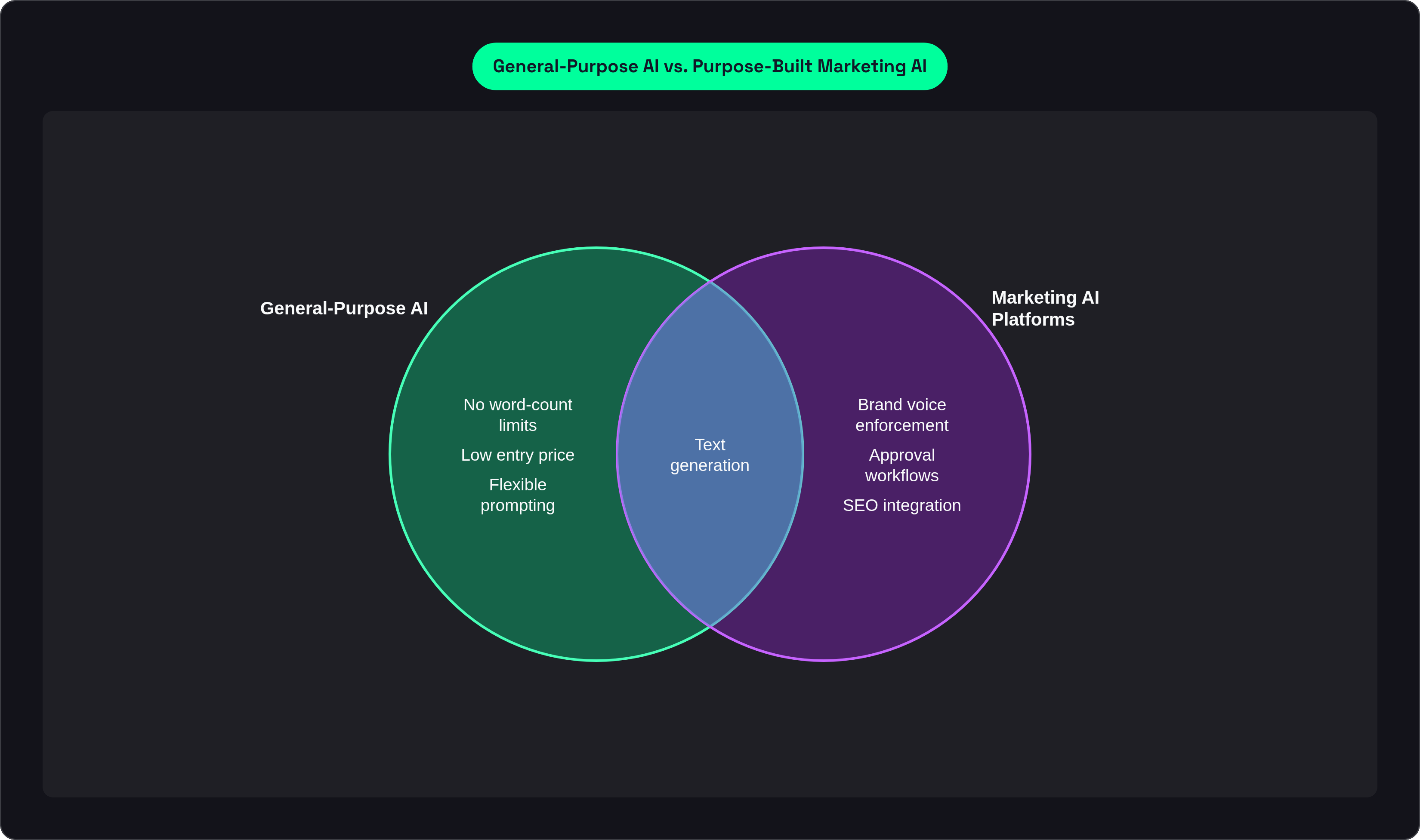
Second: brand controls. Does the plan include brand voice enforcement out of the box, or is that locked behind a higher tier, or worse, not offered at all? General-purpose tools have zero brand controls by default; that's not a knock, it's just not what they're built for.
Third: workflow depth. Every tool on the market generates text and offers templates now; that's table stakes, not a differentiator. What actually separates a $20 tool from a $99 tool is whether it handles approval flows, connects to your CRM, or automates the repetitive parts of go-to-market work that would otherwise eat an coordinator's Tuesday.
Fourth: output quality and verifiability. Does the platform fact-check its own output, support citations, or predict how a piece of copy will perform before you spend budget testing it? Or is verification a job you're doing manually, which is its own hidden labor cost?
Underneath all four sits a set of costs that rarely show up in the pricing page's hero section. Monthly billing typically runs 20% to 30% higher than annual across this market, so the "starting at" price you see in an ad often isn't the price you'll pay unless you commit for a year. SEO integrations, plagiarism checks, and AI search visibility tracking get bundled by some vendors and charged separately by others. And enterprise features like SOC 2 compliance, audit logging, and data retention controls tend to live exclusively behind custom quotes, which means the team that needs them most is also the team least likely to see a number on a public pricing page.
Map your actual needs to these four variables before you look at a single price tag, and you'll land on a better fit than the team that just sorts vendors by monthly fee.
What general-purpose AI assistants actually give marketing teams at $20/month
ChatGPT Plus and Claude Pro both sit at $20/month; ChatGPT's Team plan starts at $25 per user per month if you need multiple seats under one account. At this price, you're buying flexible, high-quality language generation with no article caps and no word-count ceiling, which makes it a low-risk way to experiment before committing to anything heavier.
Here's what you don't get. There's no brand voice enforcement, so every person on your team prompts independently and output consistency depends entirely on how disciplined each individual is about following a style guide they may or may not have memorized. There are no marketing-specific templates, no approval workflows, no team governance layer. No native SEO tooling, no fact-checking, no performance prediction. And if you're in a regulated industry that needs an audit trail or content data retention controls, you won't find them here.
So what's the real cost of a $20 tool? It's not the subscription. It's the hours your team spends prompting from scratch, reviewing output for brand consistency, and manually enforcing the standards that a purpose-built platform would automate. That labor cost is invisible on a budget spreadsheet, which is exactly why it gets missed.
This tier fits individual contributors or very small teams with strong prompt discipline and no formal brand governance requirement. If that's not your team, the $20 price tag is a mirage.
Jasper's per-seat model: what $59/seat/month includes and where costs compound
Jasper's Pro plan runs a significant per-seat fee per month on an annual commitment, or $69 per seat monthly, and includes one seat, two Brand Voices, and five Knowledge Assets. What you get for that money is meaningfully different from ChatGPT: over 100 marketing-specific agents, a Canvas workspace built for collaborative editing, and brand voice enforcement backed by a Model Context Provider that extends that same brand voice into external AI tools you might already use. Jasper also carries SOC 2 Type II certification, audit logging, custom data retention settings, and a guarantee that customer data doesn't train its models. For a compliance-conscious team, that's not nothing.
Here's where it gets expensive fast. A five-person team on Jasper Pro runs a substantial sum each month, because per-seat pricing scales linearly with no team discount until you graduate to the custom-quoted Business tier. Want SEO mode or plagiarism checking? Those require paid integrations with Surfer SEO and Copyscape, neither of which is included in the base plan. Business tier unlocks unlimited customization and API access, but it comes with a 12-month minimum and a price you won't see until you talk to sales.
One more wrinkle worth flagging: promotional first-year pricing across this market, Jasper included, can jump 30% to 50% at renewal. Read the annual agreement terms before you sign, not after your card gets charged the second time.
Jasper reports tens of thousands of unique Brand Voices created on its platform, which tells you real enterprises are using this for real brand governance work. But the per-seat structure makes it a tool best suited to teams where brand consistency and compliance are the top priority and headcount is small enough to keep the seat math manageable.
Copy.ai's GTM pivot: what workflow automation is worth at $36–$1,000/month
Copy.ai has stopped calling itself a content generation tool. It now describes itself as a go-to-market AI platform, and the pricing structure reflects that shift: Chat plan at a low monthly rate annually, Pro at a mid-tier monthly rate annually with unlimited word generation, and a Growth plan at a four-figure monthly rate that includes 75 seats. That last number matters because it's a fundamentally different math than Jasper's linear per-seat scaling; at 75 seats, the effective per-user cost drops well below $15.
What makes Copy.ai distinct in this comparison is its CRM data connections, which let content output pull directly from pipeline data. No other tool here goes that deep on linking content to sales workflow. If your team is trying to automate a GTM sequence rather than just write blog posts faster, that's the differentiator that matters.
The tradeoffs are real, though. Raw content quality on long-form writing lags Jasper's output by most accounts. There's no native SEO integration, so a team that needs search-optimized content has to layer something else on top. And Copy.ai has changed plan names and pricing multiple times during this repositioning, so treat any number here as a starting point and verify current pricing before you build a budget around it.
Right fit: revenue-focused teams that need content tied to pipeline data and automated GTM sequences, not teams whose top priority is editorial polish or search rankings.
Writesonic's SEO and AI search visibility features across its $39–$399/month tiers
Writesonic rebranded itself as an "AI Search Visibility Platform," which tells you where the product roadmap is headed: the writing tool is now the baseline, and tracking how your brand shows up in AI-generated search results is the headline feature.
The tiers, all priced annually: Lite at $39/month gives one user and 15 articles monthly with no GEO tracking. Standard at $79/month bumps that to 30 articles, still no GEO tracking. Professional at $199/month adds a second user, 100 articles, and GEO tracking for AI prompts. Advanced at $399/month scales to five users, 200 articles, and more advanced GEO features.
What's notable is what Writesonic bundles that competitors charge separately for: native Surfer SEO integration, a built-in fact-checker with citation support, and real-time web access, all included rather than tacked on. The GEO tracking capability, which monitors how your brand appears in ChatGPT, Perplexity, and Google AI Overviews, matters more each year as search behavior shifts away from ten blue links and toward AI-generated summaries.
The catch: the features that justify jumping to a higher tier, GEO tracking and multi-user access, only unlock at Professional and above. Lite and Standard are content generation tools with SEO layered in, not the full platform Writesonic is now positioning itself as.
Best fit: content-heavy teams with an active SEO mandate who are starting to care about AI search visibility. Less suited to teams whose main need is brand governance or workflow automation, where Jasper or Copy.ai respectively make more sense.
Anyword's performance prediction model and what the $49–$99/month entry price actually buys
Anyword's pitch rests on a specific claim: its prediction model identifies which copy variation will outperform with markedly higher accuracy, compared to a much lower rate for a generic model like GPT-4o. If that number holds up in your actual use case, and it's worth testing rather than taking on faith, it reframes what you're paying for. The value isn't cheaper content. It's fewer revision cycles and better conversion rates on the content you already have.
Anyword shifted its pricing model in 2025 from word-count-based billing to value-based billing, and every paid plan now includes unlimited word generation. Starter runs $49/month, or $39/month billed annually. The Data-Driven team tier costs $99/month, or $79/month annually, with extra seats at $59/month each ($49 annually) up to a defined cap. Business and Enterprise tiers are custom quoted.
That move away from word-count billing removes a hidden cost trigger that trips up teams at other vendors: you no longer get penalized financially for producing more content. Worth flagging, though, that performance prediction strength doesn't substitute for editorial workflow tools or deep brand governance. A team that needs both prediction and brand enforcement may end up running two tools rather than one, which is its own cost to factor in.
Best suited to performance marketing and demand-gen teams running high-volume copy tests, where the conversion lift from better-performing variations justifies the price over cheaper generation-only alternatives.
The SEO add-on question: when Surfer SEO is a separate budget line vs. already bundled
Surfer SEO's pricing runs from $49/month on the Discovery plan up to a few hundred dollars per month for Peace of Mind on monthly billing, with Enterprise sitting at a considerably higher custom tier. The realistic entry point for most content teams is the Essential plan at $99/month, or $79/month annually, which includes 30 Content Editor articles, unlimited keyword research, and two team members.
Want brand monitoring inside ChatGPT and Perplexity? That's the AI Tracker add-on, a notable additional monthly fee for 25 prompts, on top of whatever base plan you're already paying for. Writesonic, worth noting, folds that same kind of AI search tracking into its Professional tier base price rather than charging separately.
So here's the actual comparison question: is Surfer a separate line item on your budget, or is it already baked into what you're paying? Jasper users who need SEO mode pay for Surfer on top of their per-seat Jasper cost, which means that $99/month stacks directly onto whatever the team's Jasper bill already runs. Writesonic's native Surfer integration changes that math at the Professional tier, since you're not paying for the same capability twice. If your team already has a standalone Surfer subscription, subtract that cost before comparing it against Writesonic's higher tiers, because otherwise you're double-counting.
Surfer counts more than 150,000 customers, which suggests it has become close to a standard layer in content workflows regardless of which AI writing tool sits on top of it. Many teams are paying for it already, whether or not their main tool's pricing page accounts for that.
Enterprise considerations: Writer.com and when custom pricing is actually the right answer
Writer is built on a different premise than everything else in this comparison. It's not a writing assistant with brand features bolted on; it's a platform for building and deploying custom AI agents across marketing, sales, operations, and support, running on its own Palmyra family of language models rather than a licensed general-purpose model.
Pricing is deliberately opaque. Every enterprise plan requires a custom quote, which tells you the product is sold as a platform contract, not a software subscription you swipe a credit card for. Writer raised a $200 million Series C, and that kind of capital signals the scale of enterprise infrastructure the company is building toward, not a tool aimed at a five-person marketing team's monthly budget.
This tier makes sense for organizations where content governance spans multiple departments rather than living solely inside marketing, for teams that need a model trained on their own internal data rather than a general model with a brand voice layered over it, and for procurement processes that require vendor security reviews, custom service-level agreements, and dedicated support that standard SaaS tiers simply don't offer.
For most readers of this comparison, Writer is the tier where, if you have to ask what it costs, you're probably not the buyer. But it's worth knowing it exists, if only so a mid-market team doesn't waste six weeks in a sales cycle trying to force-fit an enterprise platform into a budget built for five seats.
A side-by-side cost model for three realistic team sizes
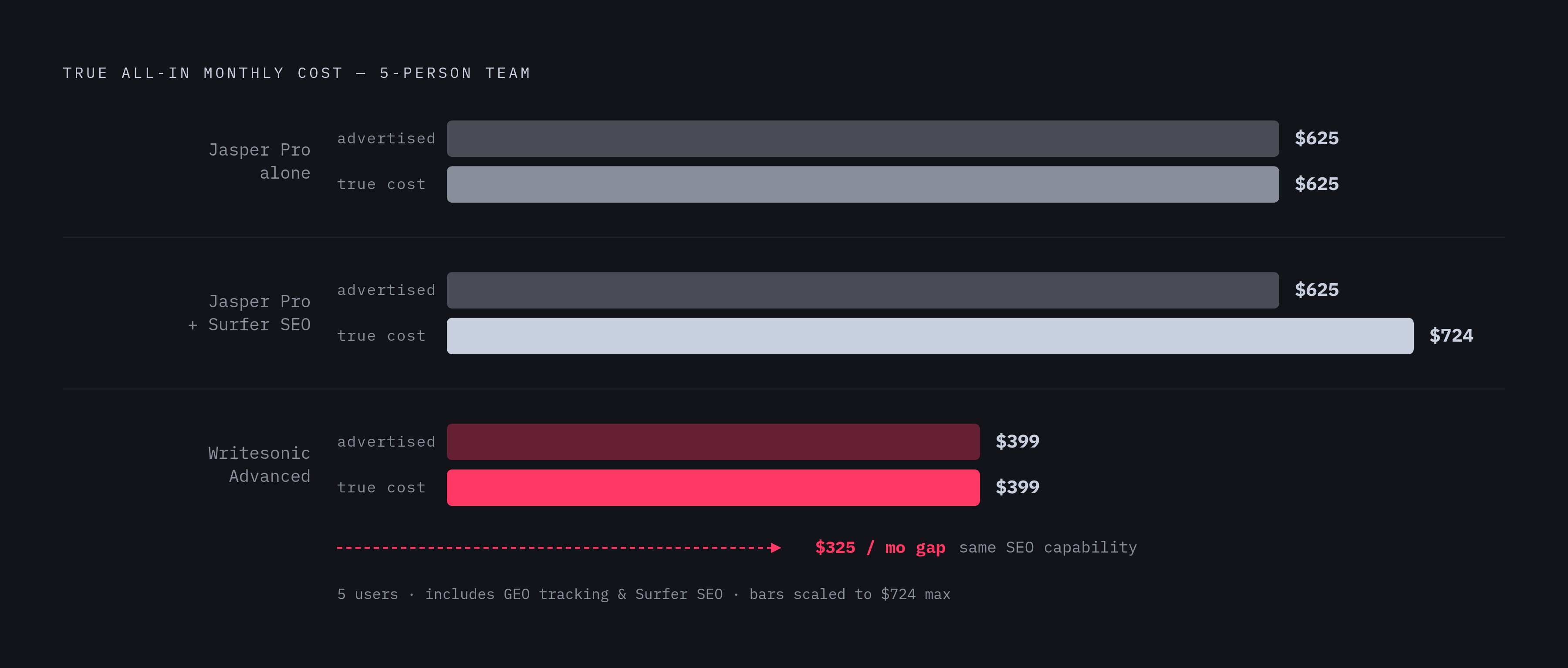
Numbers mean more next to each other than they do alone, so here's what three realistic team sizes actually pay.
A solo content marketer or two-person team choosing between ChatGPT Plus at $20/month, Anyword Starter at $39/month, and Writesonic Lite at $39/month is really deciding whether brand consistency or SEO support is worth roughly double the baseline price. If neither matters yet, stay at $20 and revisit later.
A five-person marketing team faces a wider spread. Jasper Pro at $625/month total (five seats at $59 each, plus the base) sits against Writesonic Advanced at $399/month, which covers five users, 200 articles, and GEO tracking, and against Copy.ai's Growth plan at $1,000/month for 75 seats of workflow automation the team probably won't fully use at that size. Between Jasper and Writesonic alone, that's a substantial annual gap, before anyone adds a single integration.
Now take that same five-person Jasper team and add SEO capability, since Jasper doesn't include it natively. Jasper Pro at $625/month plus Surfer's Essential plan at $99/month annually pushes the real monthly cost considerably higher, well above Writesonic Advanced's all-in $399. That gap is the whole point of this piece: the sticker price told you Jasper was competitive, and the total cost told you something else entirely. Run that math for your own team size before you sign anything, because the tool that looks cheapest on the pricing page is rarely the one that ends up cheapest on the invoice.