Brand Voice Training for AI Writing Tools
Turn brand voice into actionable training data or AI writing tools will ignore it.
Brand voice is not a mood board. It's definitely not a vibe, and it's not three adjectives on a slide deck. In the context of training an AI, it is a set of specific, reproducible decisions about language, and if you can't articulate those decisions with enough granularity to evaluate a piece of writing against them, the model has nothing real to work with. This is where most teams lose before they've even opened a tool.
Four dimensions need to be nailed down before anything else, and I'd argue most brands have seriously documented maybe one of them.
Personality adjectives should be behavioral descriptors, not aspirational ones. "Confident" tells a model nothing useful. "Uses declarative sentences, rarely hedges with qualifiers, and never apologizes for a strong point of view" does. The difference between those two descriptions is the difference between usable training data and wishful thinking on a slide.
Vocabulary preferences matter more than people expect. Which terms does the brand own? Which does it avoid? A B2B SaaS company selling to developers handles technical language completely differently than one selling to CMOs, and that distinction needs to be explicit because the model will make assumptions either way. Better that it's making yours.
Sentence structure patterns are what actually make voice feel consistent across writers and formats: length norms, use of contractions, passive versus active preference. These textural decisions are almost universally underdocumented, because nobody thinks they matter until the output sounds like everybody else's output.
Perspective and opinion is where most voice documents fail entirely. A brand that never takes a position on anything is a brand the model renders as bland, because blandness is simply the default when there's no other instruction to override it.
Voice, tone, and channel rules are related but distinct, and conflating them is one of the most common training errors I see. Voice is the brand's personality: consistent across every piece of content. Tone adapts by context; an urgent crisis email sounds different from a welcome nurture sequence, but both should feel like the same organization wrote them. Channel rules govern format-specific constraints, because a homepage header and an executive LinkedIn post should feel related without being structurally interchangeable.
The documentation problem runs deeper than most teams admit. A voice brief too long to use in practice gets ignored. One survey of more than a thousand knowledge workers found that 92% want AI that tailors output to brand guidelines. The bottleneck has always been input quality, and that hasn't changed.
Choosing the right training method for your situation
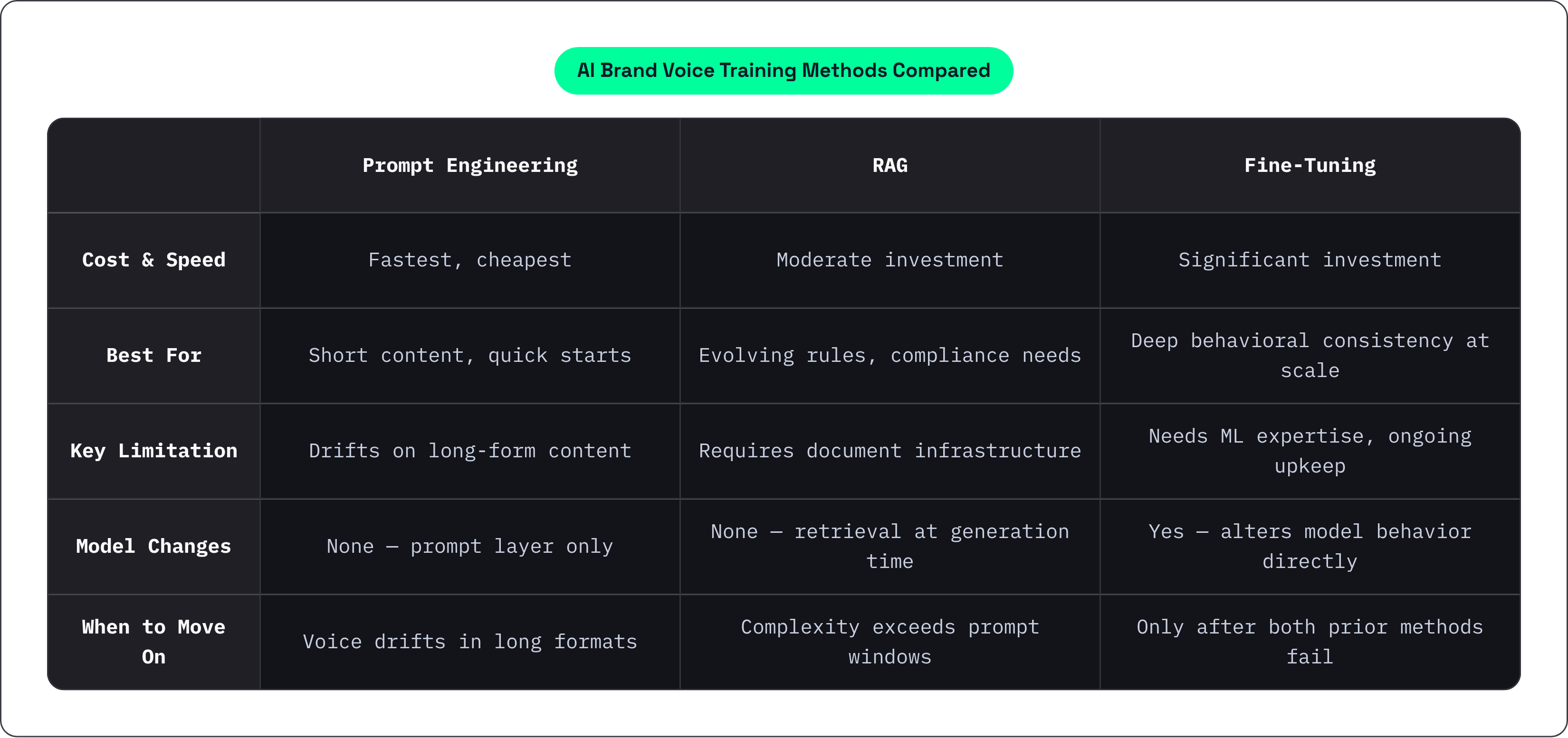
Three methods exist on a spectrum of cost, control, and durability. The right choice depends on your actual situation, not on which approach sounds most sophisticated at the offsite.
Prompt engineering
This is the fastest and cheapest path, and it requires no changes to the underlying model. A well-constructed brand voice prompt includes a defined role for the model, a clear audience, a stated objective, structural direction, approved terminology, banned phrases, and worked examples of the voice in action.
That last element matters more than most teams realize. Few-shot examples, actual pieces of content that demonstrate how the voice behaves under a real assignment, teach the model far more than a list of adjectives ever will. "Direct and warm" is interpretable a hundred different ways. A paragraph that demonstrates those qualities removes the ambiguity.
Here's the hard limit: output length. The longer the piece, the more likely the model drifts back toward default assistant language, which is to say, toward a voice that belongs to no one in particular. Prompts alone shouldn't be trusted for landing pages, case studies, or executive messaging. For those formats, you need something more durable.
RAG (retrieval-augmented generation)
RAG is the middle-ground approach. Rather than asking the model to "remember" brand rules from a prompt, RAG pulls from approved documents at generation time, so the brand knowledge doesn't need to fit inside a prompt window.
This is the right fit when brand rules evolve frequently, when content needs current product context, or when compliance requires clear provenance for every claim. The governance advantage is real: source data stays separable from the model, which matters considerably in regulated industries.
Fine-tuning
Fine-tuning changes how the model behaves, not what it knows. That distinction is the most commonly misunderstood aspect of the technique, and collapsing the two leads teams to apply it in situations where RAG would have worked fine and cost a fraction of the effort.
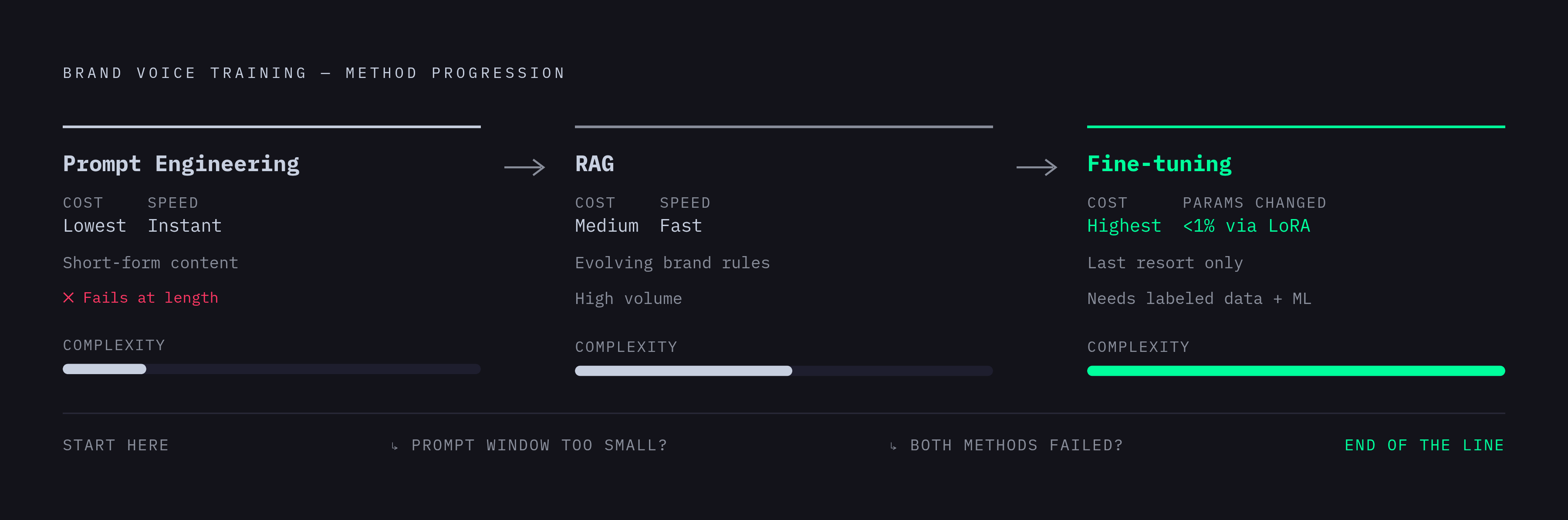
It requires labeled training data, ML expertise, and ongoing maintenance. The barrier has dropped since the adoption of LoRA and QLoRA techniques; adapter matrices can represent less than 1% of total model parameters, which reduces computational cost substantially. But it remains a significant investment, and most marketing teams shouldn't start here until the other two approaches have genuinely, demonstrably failed them.
The practical decision logic is simpler than the technical literature makes it sound. Start with prompt engineering and curated examples. Layer RAG when content volume or brand complexity grows beyond what prompt windows can contain. Consider fine-tuning only when the other two consistently fail to hold the line, and even then, go in with clear success criteria. A large share of enterprise deployments combine RAG and fine-tuning: RAG to keep knowledge current, fine-tuning to enforce consistent behavioral patterns. That combination makes sense at scale. As a starting point, it's almost always overkill.
Building the input corpus that actually teaches your voice
The model learns from examples, not descriptions. Teams most consistently underweight this, probably because compiling good examples is unglamorous work that doesn't feel like strategy. It feels like homework.
Your training corpus should include your best-performing, most on-brand existing content: blog posts, LinkedIn pieces, press releases, sales emails. Not everything the brand has ever published. Specifically the content that reflects the brand at its clearest, written when the voice was understood and intentional. The distinction matters because the model will faithfully learn from bad examples just as readily as from good ones. It has no taste. That's your job.
Channel-specific samples matter too. Don't aggregate everything into a single undifferentiated pile. The model needs to understand that the brand's voice on a product page operates differently than in a thought leadership essay, even when the underlying personality is the same. Without that separation, the model averages across formats and produces something that doesn't fully belong to any of them.
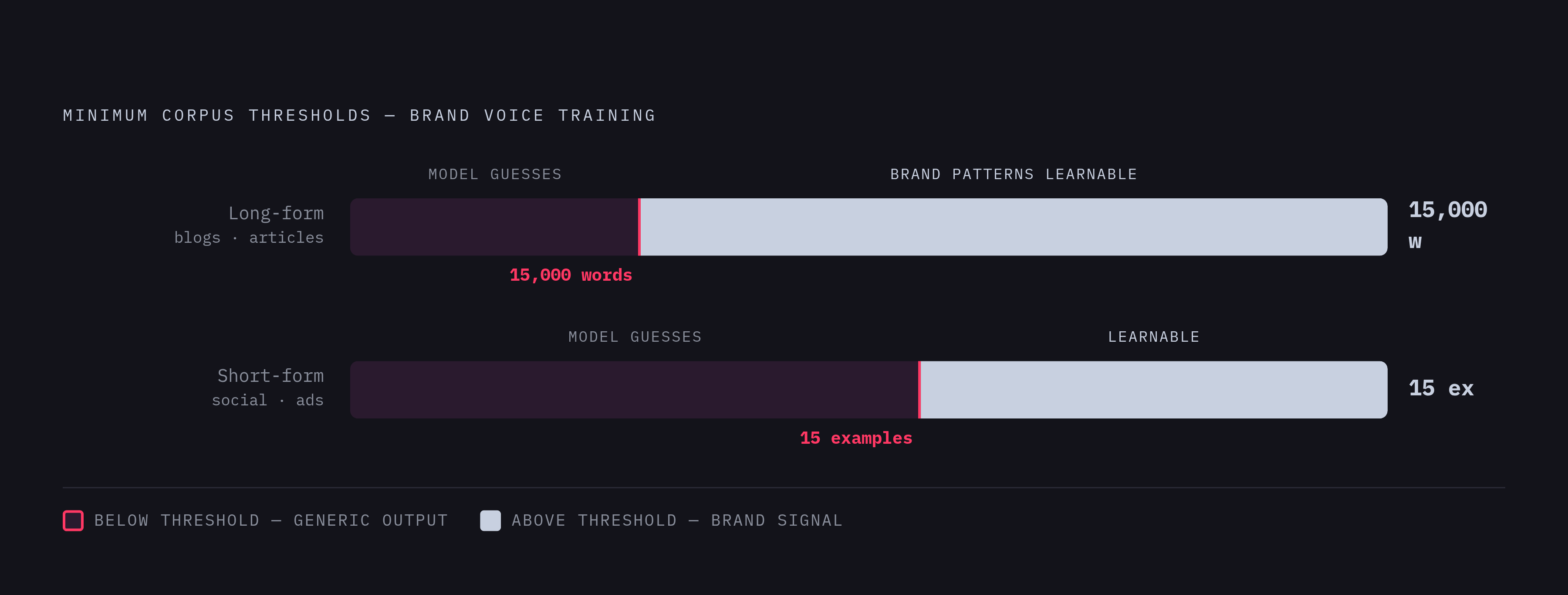
Typeface's published methodology offers useful minimum thresholds: 15,000 words for long-form content such as blogs and articles, and up to 15 examples for short-form content like social posts and ads. Below those thresholds, output quality degrades noticeably because the model has too little signal to distinguish the brand's patterns from generic defaults.
What to exclude is equally important, and in my experience, this is where teams get sentimental. Leave out ghostwritten content where the voice wandered, early-stage material written before the brand voice was established, and anything produced under a prior agency relationship with a different brief. Those pieces introduce noise that counteracts the signal you're trying to build. If you're genuinely uncertain whether a piece belongs in the corpus, the uncertainty is the answer.
Persona-driven framing adds another anchor. Assigning the model a specific role, something like "you are a senior writer at this company who has covered this topic for three years," anchors tone and perspective more reliably than adjective lists. It gives the model a cognitive position to write from, not just rules to follow.
Label examples by intent. Train the model to distinguish a thought leadership post from a product announcement from a nurture email. Same voice, different register. Without that labeling, you get something generic that doesn't serve any of the intended purposes, and everyone on the content team will know something's off but won't be able to articulate what.
Setting guardrails so the voice holds at scale
Guardrails are the difference between a one-time training exercise and a system that actually holds. Without them, the voice you spent time calibrating degrades as soon as content volume increases. And volume will increase; that's the whole point.
Three categories need explicit definition, and none of them are glamorous.
Terminology controls: approved product names, preferred category language, banned competitor references. These are mechanical, but they're the first thing to break at scale and the easiest to enforce if you've written them down somewhere people can actually find.
Tone floors and ceilings: what the brand will never say (hyperbolic claims, dismissive humor, passive-aggressive copy) and what it always does (leads with the reader's problem, defaults to active voice, treats the audience as intelligent). Defining both ends of the range gives reviewers and automated systems something concrete to evaluate against, rather than asking everyone to rely on instinct in the moment.
Format constraints by channel: word count ranges, heading conventions, CTA norms. Voice consistency is partly structural, and structural inconsistency reads as voice inconsistency to the audience even when they can't articulate why something feels slightly off.
The governance reality right now is that AI is generating content faster than brands can manually review it, and that gap is widening. Which means some guardrails need to be enforced by the tool itself, flagging off-brand tone or restricted terminology before content reaches a human editor. Final judgment on nuanced or high-stakes output stays human. Automated enforcement and human review operate at different layers of the same system; they're not competing for the same role.
Ownership matters as much as content. A named person needs to own the brand voice document, with actual authority to update it when positioning shifts. Without active ownership, the AI's effective brand voice slowly becomes a faithful reproduction of old content and stale messaging. The document atrophies quietly. The training degrades with it. By the time anyone notices, you've published a lot of content that sounds like who you used to be.
How leading AI writing platforms handle brand voice training natively
Platforms vary substantially in how they approach brand voice, and the difference isn't just feature depth. It's architectural: whether brand voice sits as an enhancement layer, a governance layer, or something applied at the content-type level. That distinction determines how reliably voice holds as volume scales, and it's worth understanding before you're locked into a contract.
Jasper is the incumbent in the enterprise AI writing category, with a substantial user base that includes a significant share of the Fortune 500. Its approach is preventive: the platform flags off-brand tone instances and surfaces recommended adjustments before publication, rather than generating content and leaving review entirely to the user. Jasper Pro is accessible at $69 per month without requiring a sales process, which makes it viable for teams operating below enterprise scale.
Writer positions brand voice as a governance layer rather than a prompt enhancement. Its Graph RAG architecture connects AI agents to proprietary internal data systems, including Snowflake, Databricks, and internal document repositories, so outputs are grounded in actual organizational knowledge rather than generalized training data. Writer fits large content teams and regulated industries where data security certifications are non-negotiable.
HubSpot Breeze makes brand voice available across six languages and applicable to a range of content formats including blogs, emails, landing pages, SMS, and social content. For teams already operating inside the HubSpot ecosystem, this integration removes the friction of maintaining voice configuration across multiple tools. It's available on Professional and Enterprise tiers.
Typeface trains directly on uploaded examples rather than descriptions. The corpus-based approach described earlier in this piece isn't a workaround for Typeface; it's the native methodology. The published minimum thresholds give teams a concrete readiness benchmark before training begins, which is more practically useful than most platforms' documentation on the subject.
Manifestly takes a strategy-first approach where brand voice training is embedded in the content brief rather than appended at the generation step. The workflow combines AI-powered writing with human editorial oversight, which addresses the governance gap that pure-generation tools tend to leave open.
When evaluating any platform, three questions apply regardless of vendor: Does the tool treat brand voice as a primary input or an afterthought? Does it flag violations before publication rather than after? Does it support channel-level customization, or does it apply a single voice setting across every format? The answers reveal whether the tool is architected for governance or just generation, and that distinction matters more than any individual feature comparison.
Iterating against real output: the feedback loop that keeps voice calibrated
Training an AI on brand voice is not a one-time configuration, and the degradation is subtle enough that teams often don't notice until the content has drifted substantially from where it started. It degrades without active iteration.
Three things are worth measuring consistently. Voice consistency: does output across different writers, use cases, and formats feel recognizably from the same brand? Reader response: engagement metrics and qualitative feedback from sales and customer-facing teams who actually hear how the content lands in real conversations, not in a content review meeting. Violation frequency: how often does the tool produce flagged off-brand content, and where does that clustering occur by format or topic? The pattern tells you where the training has gaps, and those gaps are rarely random.
A structured review cadence beats continuous line editing. Periodic audits of AI output against the brand voice document, systematically sampled across formats and topics, are more revealing than reviewing every piece individually. Reviewing everything doesn't scale, and it creates exactly the kind of bottleneck that defeats the purpose of AI-assisted production in the first place.
Update the training inputs when the brand repositions, when a new product category emerges for which the corpus has no examples, or when consistent drift appears in a specific channel despite guardrails. Those are the signal events. Updating without those signals introduces noise where you were trying to build clarity.
Treat the prompt and example library as a product. Version it. Assign ownership. Update it when positioning changes. A library that isn't actively maintained becomes a historical artifact, not a governing document, and the AI will faithfully reproduce the brand voice of two years ago while you're trying to go to market with something new.
The teams best positioned to catch voice drift aren't only the content team. Customer success, sales, and support hear how the brand's language lands in actual market interactions. They should have a formal channel into the review process, not as editors, but as signal sources. That input, systematically collected and acted on, is what keeps the training loop honest and keeps the voice from calcifying into something nobody on the current team would actually write.