AI Writing Tools for Enterprise Marketing Teams
Enterprise adoption of AI writing tools soared to 94%, but only 41% can prove ROI.

The pace has been genuinely startling. In 2024, just over half of marketers were using generative AI in at least one workflow. By 2026, that figure had climbed to 87%, according to Salesforce's State of Marketing data. For enterprise marketing departments specifically, those with 250 or more marketers, adoption had reached 94% by early 2026. The category went from emerging to standard operating procedure in roughly two years.
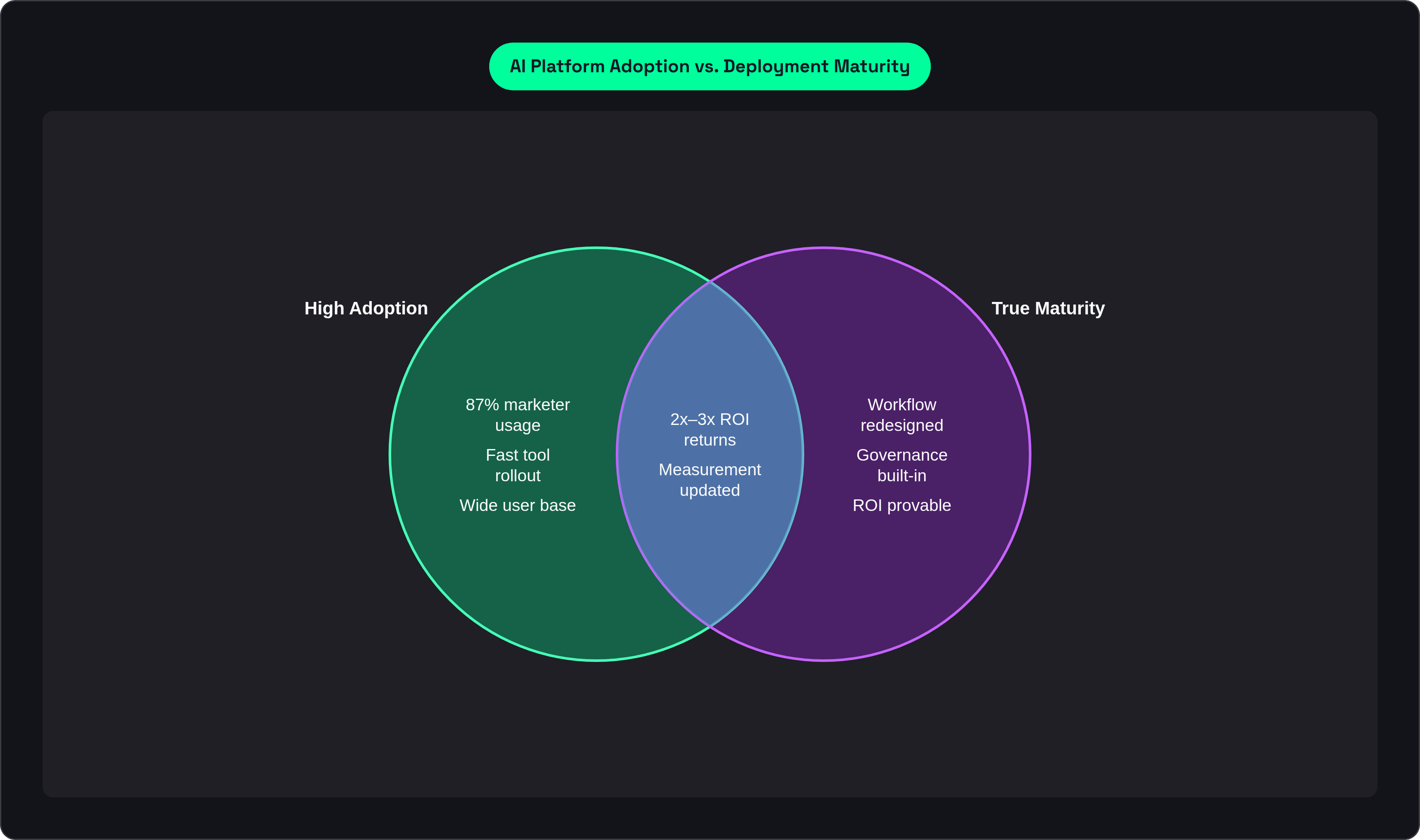
Adoption rate and deployment maturity are not the same thing, and conflating them is expensive. McKinsey's State of AI survey found that only about 1% of firms describe themselves as genuinely mature in AI deployment. The gap between tool in place and workflow actually redesigned is where most enterprise value is currently being lost, and most teams aren't even sure which side of that gap they're on.
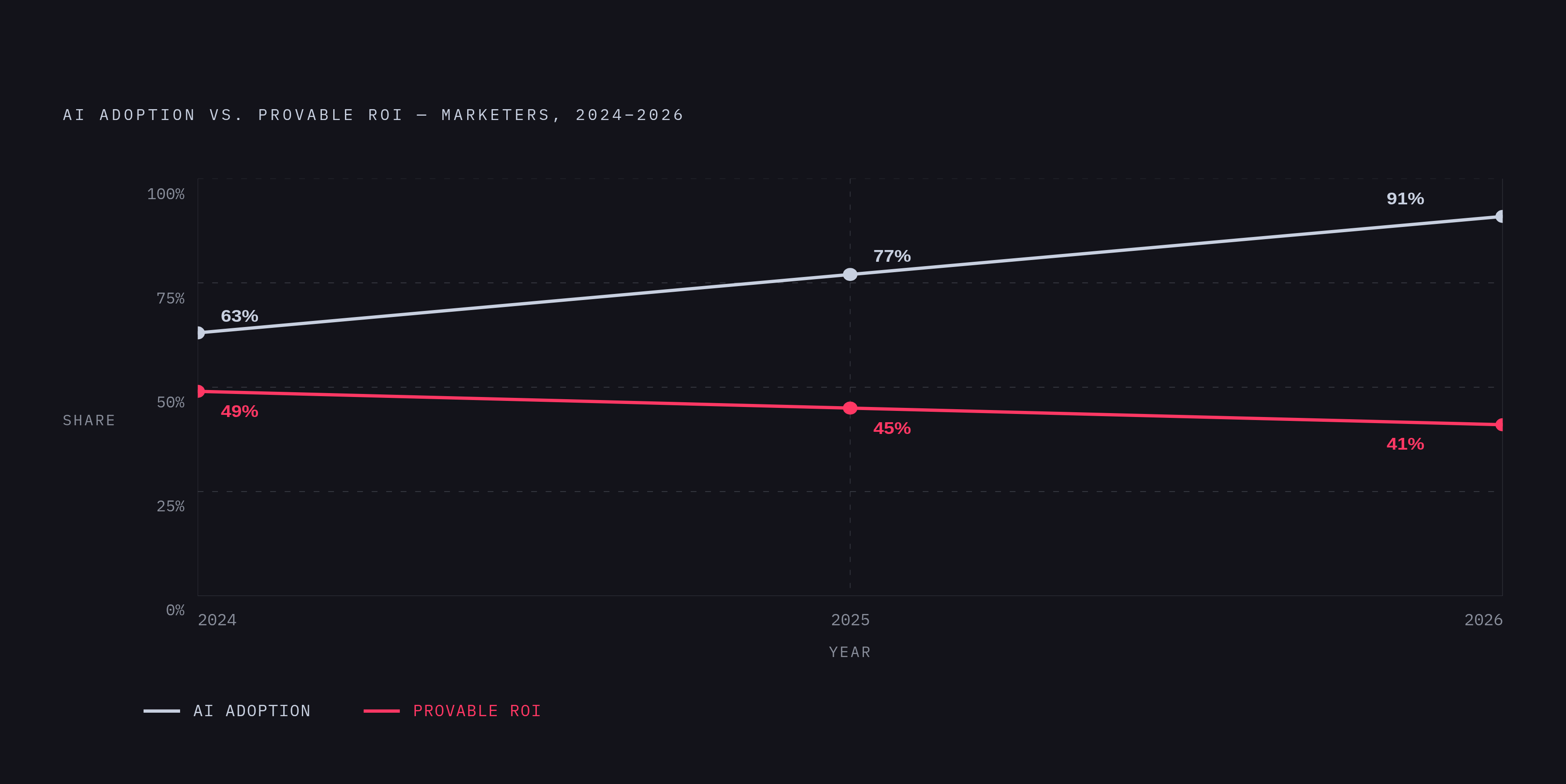
The ROI data confirms it in an almost uncomfortable way. Jasper's 2026 report found that only 41% of marketers can demonstrate AI ROI, a figure that actually declined from 49% the prior year, even as overall adoption climbed from 63% to 91% across the same period. Teams scaled faster than they built the measurement frameworks to track what the tools were returning. Among the teams that did update their measurement approach, the majority report returns of 2x to 3x or higher. So the capability is there. The discipline around proving it isn't.
The condition most enterprise marketing leaders are actually operating in right now: tool deployed, ROI uncertain, governance improvised. That's not a tool problem. It's a deployment and selection problem, and it's why platform selection requires something more rigorous than a standard feature comparison. Picking the wrong platform, or picking the right one the wrong way, doesn't just waste a budget line. It poisons the organizational appetite for the entire initiative.
The four dimensions that actually determine fit at enterprise scale
These four dimensions interact in ways that a thirty-day pilot won't surface. A weakness in any one of them can quietly undermine the others, and the compounding effects at scale show up only after the contract is signed and the rollout has already touched two hundred users.
Brand voice and consistency
Whether a tool can approximate your brand voice is almost beside the point. The real question is whether brand knowledge persists as a system property, encoded once at the organizational level and applied automatically across every user, every session, every content type. Or whether it lives in the habits of your best writers and degrades the moment someone new joins the team.
At individual scale, inconsistent brand voice is an editorial inconvenience. At enterprise scale, it's structural. Two hundred off-brand assets per quarter accumulates until it surfaces in customer research or competitive analysis, usually at the worst possible moment. The test isn't whether a tool performs well on a demo when everything is freshly configured. It's what happens three months in, across forty users, when nobody is paying close attention.
Governance and compliance
Approval workflows, role-based access controls, audit logs, output classification, prompt redaction: in enterprise software, these are not differentiating features. They are entry requirements. For financial services, healthcare, and pharmaceutical marketing, the absence of a single compliance capability (whether HIPAA, PCI, or GDPR data residency) can stop procurement entirely.
Two provisions matter beyond the standard compliance checklist, and they're easy to miss if you're moving quickly. First, whether the vendor guarantees that customer content is not used to train their models. Second, whether dedicated cloud instance options exist for organizations with proprietary content they cannot commingle with shared infrastructure. Both show up as meaningful differentiators in practice, not as fine print nobody reads.
Workflow integration and scalability
Every serious enterprise platform has an API by mid-2026. The real question is whether the integration is deep enough to eliminate handoff friction across the actual content supply chain: the CMS, CRM, email platform, and digital asset management system the team already uses. Agentic workflows that chain content steps, research, brand formatting, and human approval gates into reusable templates are now standard among the leading platforms. A tool that requires manual copy-paste at every system transition doesn't eliminate a bottleneck; it relocates it somewhere less visible, which is worse.
Output quality and strategic alignment
Speed of generation is the easiest metric to measure and the least predictive of enterprise value. The right question is whether the tool produces content that advances the strategy, or content that has to be substantially rewritten before it goes anywhere near a customer. Quality at enterprise scale means consistency across hundreds of assets over months, not peak performance on a single demo prompt. Platforms that hold strategic context automatically (the brief, the persona, the funnel stage, the competitive framing) produce better outcomes than prompt-and-polish workflows for a reason that should be obvious once you've watched it fail: the context doesn't depend on the individual writer remembering to re-enter it every time they open a new session.
How the leading platforms map to those dimensions
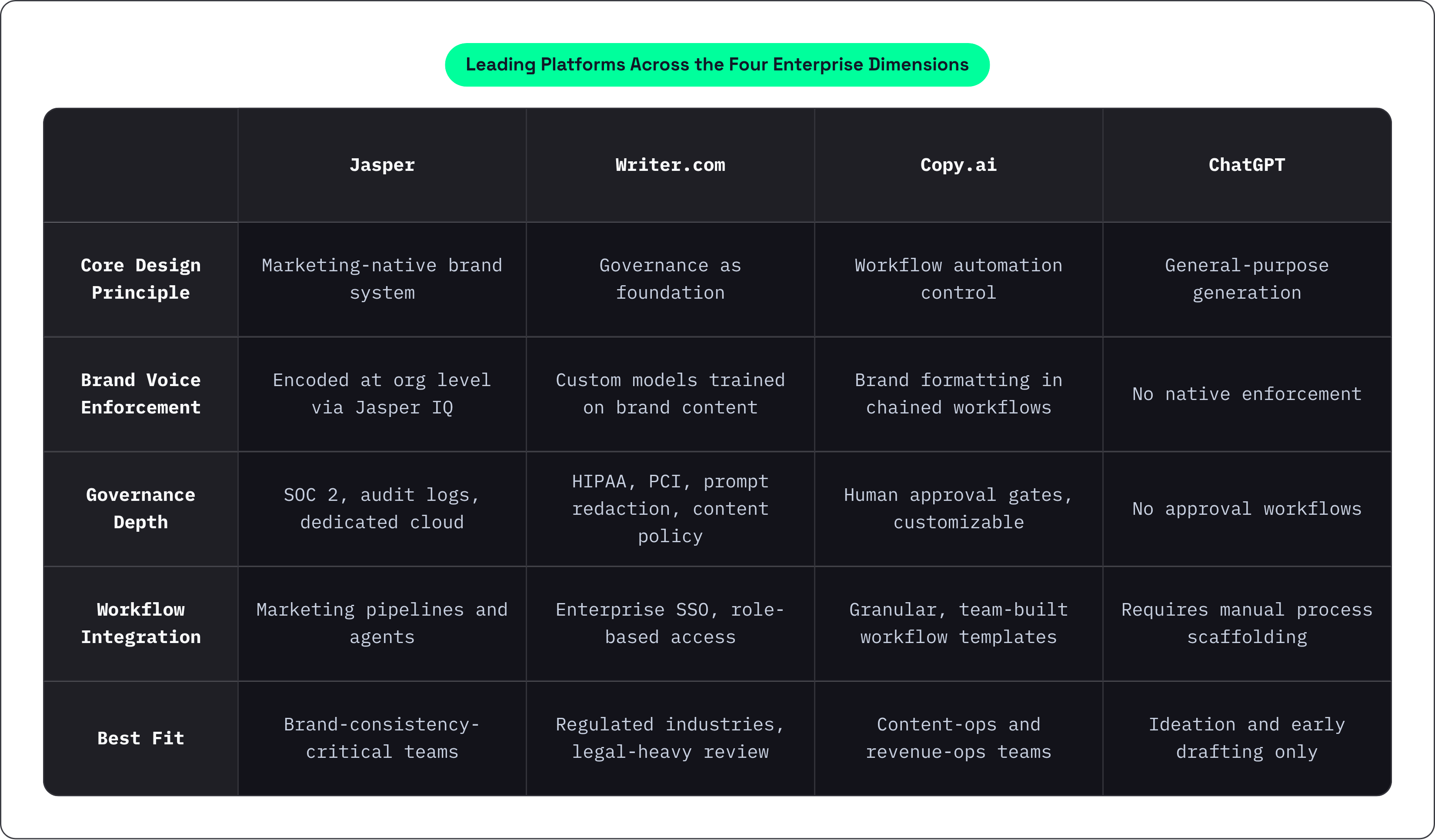
One framing note before the comparisons: by mid-2026, every serious enterprise platform ships agentic workflows, knowledge integration, and governance controls in some form. The differentiation is depth on each dimension, not checkbox presence.
Jasper
Jasper was built specifically for marketing teams, and that design choice shows throughout its architecture. Jasper IQ embeds brand voice, style guides, audience profiles, and product knowledge into every output across the team automatically, making brand consistency a system property rather than something each writer has to enforce session by session. The platform includes marketing-specific agents, team-scale content pipelines, image production, and a governance stack covering SOC 2 Type II certification, audit logging, custom data retention, no-training-on-customer-data guarantees, and dedicated cloud instances.
Jasper's fit is clearest for marketing teams where brand voice enforcement needs to be built into the platform itself, not maintained through editorial process and hope.
Writer.com
Writer.com is built around governance as its core design principle, which makes it genuinely distinctive in a category where most platforms treat compliance as an add-on to the real product. The platform uses custom Palmyra language models trained on the brand's own content and terminology. Its governance stack includes SSO, role-based access controls, audit logs, prompt redaction, output classification, and content-policy engines, with HIPAA and PCI compliance available beyond the SOC 2 and GDPR baseline.
Writer's fit is strongest for large marketing organizations in regulated industries, or environments where content routinely runs through demanding legal review before it ships.
Copy.ai
Copy.ai has repositioned itself as a go-to-market platform rather than a content generation tool. The emphasis is on automated sales and marketing workflows. Its Workflows product lets teams chain content steps, web research, brand-voice formatting, and human approval gates into reusable templates, giving content-operations teams significant flexibility to own and customize their own workflow architecture rather than adopting whatever the vendor has pre-built.
Copy.ai fits best for content-ops and revenue-operations teams that want direct, granular control over how their workflows are structured.
ChatGPT (OpenAI)
ChatGPT is where most enterprise teams start their thinking about the category, which is understandable and also where a lot of them stall. Its weekly active user base reached hundreds of millions by mid-2025, and its generation capability at the Plus tier is strong relative to its a low per-user monthly price point price point. But its enterprise limitations are structural: no native brand consistency enforcement, no approval workflows, no marketing automation integration. It works at scale only with significant manual process scaffolding around it, and that scaffolding is always the first thing to erode when team pressure increases, which is precisely when you need it most.
Its most practical role in an enterprise stack is supplementary: useful for ideation and early drafting, not as the platform anchoring primary content production.
The stack pattern that actually emerges
Most high-performing content teams combine tools rather than consolidating on one. A general-purpose AI handles ideation, a specialized platform anchors primary production, editing tools manage quality control. The decision about which specialized platform anchors the stack is exactly where the four-dimension framework applies most directly.
The productivity and ROI case (and why measurement needs to keep pace with adoption)
The productivity numbers are large enough to warrant skepticism, but the data behind them is now consistent enough across enough sources that dismissing them takes more effort than accepting them. McKinsey's Global AI Survey finds AI content drafting delivers 3.2x ROI on average, the highest of any AI marketing application tracked. HubSpot's AI Trends 2026 data reports marketers recovering more than six hours per week on average, with senior practitioners reclaiming closer to eight to ten hours weekly and junior staff three to four. That time shifts from first-draft production toward strategy and editing, which is the right direction for any organization trying to get more strategic output from the same headcount.
Payback timelines have also compressed significantly. The median payback period on AI tooling investments reached 4.2 months in 2026, down from 7.8 months in 2024. For content-heavy teams, payback arrives in under three months. Gartner data shows 71% of marketing leaders who adopted AI tools in 2024 and 2025 reported positive ROI within six months, compared to 48% two years prior.
And yet: only 41% of marketers can prove the ROI that many of them are in fact generating. Teams deployed faster than they built dashboards and attribution models capable of tracking what changed. I've seen this play out repeatedly, and the pattern is consistent: the measurement conversation gets deferred because there's already enough friction in the deployment itself, and by the time someone asks for proof, the baseline data that would have made comparison possible is gone.
The direct implication for enterprise buyers is this: selecting a tool without simultaneously updating measurement frameworks produces exactly the ROI ambiguity that makes it difficult to justify continued investment or expand the rollout. Tool evaluation and measurement design should run in parallel. Treating them as sequential is how teams end up six months in with no defensible answer to whether any of it was worth it.
Where governance becomes the hidden constraint in enterprise deployments
Governance looks like a procurement checklist during evaluation. It becomes an operational constraint during deployment, and the gap between those two experiences is where enterprise rollouts slow down or quietly fail. This is not a subtle problem. It's one of the most consistent failure patterns in enterprise AI deployment, and it's almost always avoidable.
Three failure modes appear with enough regularity to take seriously. Inconsistent brand output across users: when brand voice isn't encoded into the platform itself, it degrades as team size grows and context gets lost between sessions. Ungoverned content reaching legal or compliance review: without approval workflows and output classification, content that shouldn't ship gets caught downstream, creating bottlenecks rather than eliminating them, often with organizational friction that outlasts the specific incident. Data security gaps surfaced during procurement: a tool that passes marketing's evaluation can fail IT or legal review on SOC 2, data residency, or training-data-use provisions. Finding this out after rollout is expensive in time and credibility, and it poisons the internal perception of the whole initiative in ways that are hard to recover from.
The compliance dimension is also expanding. As AI-generated content becomes more prevalent, regulatory scrutiny of AI-assisted marketing claims, required disclosures, and data use practices is increasing across industries. Governance infrastructure that felt optional a few years ago is becoming a baseline expectation.
The practical architecture for a defensible enterprise rollout includes role-based access that matches the existing organizational hierarchy, audit logs that satisfy both internal marketing operations and external compliance review, human approval gates built into the workflow rather than retrofitted afterward, and a clear vendor policy on customer content in writing. Teams that deploy successfully treat governance architecture as a design decision made before the first user logs in.
How to run an enterprise AI writing tool evaluation that produces a defensible decision
The goal of an enterprise evaluation isn't finding the highest-scoring tool on a feature matrix. It's identifying the tool whose strengths align with the team's most critical constraints (whether that's brand governance, workflow integration, security, or content volume at scale). The distinction matters because the highest-scoring tool on a generic matrix is often not the right tool for a specific organization's actual bottleneck.
Audit the current content supply chain before touching a tool. Where does content actually slow down? First draft? Review cycles? Brand consistency checks before anything goes to legal? The tool should solve the real bottleneck, not add speed to a step that isn't the constraint. Map the existing martech stack and identify which integrations are required for the tool to replace manual steps rather than add a new one alongside them.
Define success metrics before the pilot starts. Fewer than half of marketers can currently prove AI ROI, which means the measurement framework needs to exist before adoption begins, not after. Useful metrics include time-to-publish per content type, revision cycles per asset, brand consistency audit scores, and content volume per marketer per week. These baselines need to exist before the pilot. Without them, post-pilot comparisons are informed opinion at best, and informed opinion doesn't survive a budget review.
Run a real-work pilot, not a demo scenario. Give each shortlisted tool an actual content brief, real work the team would have produced regardless, and evaluate on brand fidelity, revision effort required, and governance friction. Not raw generation speed. Include IT and legal in the pilot scope if data security and compliance are procurement requirements. Discovering a deal-breaker after the marketing pilot wastes everyone's time and creates the kind of skepticism that outlasts the platform decision.
Evaluate the workflow, not just the output. How much setup does each asset require? Does brand context persist automatically or have to be re-entered each session? Where do human approval steps live in the tool's workflow, natively or improvised around it? A tool that produces strong output but requires significant manual scaffolding to maintain brand consistency doesn't scale, because that scaffolding is always the first thing to erode under team pressure.
Build the governance architecture before broad rollout. Define roles, access levels, and approval gates before the first user onboards. Configure brand knowledge and style guides into the platform at the organizational level. Get the vendor's data use policy in writing, not as a verbal commitment during a sales call. Platforms that encode brand voice and strategic context directly into the generation workflow produce on-strategy output by default rather than by individual effort, and that default is the design property actually worth selecting for.
The teams that take these steps seriously, in order, before the pressure to move fast overrides the process, consistently outperform the teams that treat platform selection as a marketing decision and governance as a later IT problem.