Editorial Mission Statement for Brand Blogs
A mission statement turns unfocused content into strategic advantage for your brand.

Joe Pulizzi introduced the content mission statement to digital marketers in 2011 at the first Content Marketing World conference. He didn't invent it. He borrowed it from traditional publishing, where editorial meetings at magazines and newspapers were already governed by a stated mission. Editors used that mission to accept or kill story pitches. A brilliant idea that didn't fit the publication's scope was still a no. Quality was never sufficient justification on its own, and everyone in the room knew it.
Before that moment, product brands creating content had no equivalent discipline. They were producing blog posts and white papers and newsletters without the editorial infrastructure that gave those formats their power in the first place. The formats were borrowed from publishers. The rigor was not.
That's the gap Pulizzi was addressing. And the reason the concept held up, and still holds up, is that it wasn't invented for marketing. It was already proven in contexts where editorial coherence was a survival condition, where a magazine that lost its sense of self lost its readers, then its advertisers, then its existence. Marketers adopted a concept with a working lineage in newsrooms. That lineage is worth remembering when the mission starts to feel like a formality.
Why Most Content Programs Fail to Gain Traction Without One
The performance data is sobering. CMI's 2025 B2B Content Marketing report, fielded with close to a thousand respondents, found that 58% of B2B marketers rate their content strategy as only moderately effective. Among those, 42% attribute the underperformance in part to a lack of clear goals. That is the exact symptom a well-constructed mission statement treats, and yet most programs still don't have one. Only 39% of B2B content programs have a documented content strategy at all, and those that do are roughly twice as likely to report success.
Volume doesn't solve it. Research by Ahrefs has found that the vast majority of online content earns zero backlinks, and social shares concentrate in a small fraction of published articles. Publishing more without strategic clarity does not close that gap; it widens it, because you're adding to a pool of content that already has more supply than distribution can absorb.
The structural reason programs bloat without a mission is simple: when there's no governing framework, every content request competes on equal footing. A stakeholder wants a product-feature post; a sales team wants a case study; a PR team wants a thought leadership essay. All three land in the queue with equal weight, the program tries to accommodate all of it, and the resulting body of content serves no coherent audience. It serves everyone in the room, which means it serves no one reading it.
What documented strategy actually correlates with is telling. Top-performing content marketers know their audience, set goals aligned with organizational objectives, measure performance effectively, and demonstrate thought leadership. Those aren't discrete achievements you check off separately. They're all downstream from one upstream decision: defining, in writing, who you serve and why your content exists. The mission statement is the precondition. Everything else is execution.
The Three Components Every Effective Editorial Mission Statement Contains
Practitioner consensus has converged on three required elements, and they work in sequence. Get one wrong and the whole thing unravels.
The first is the target audience: the specific people the publication serves. Not a demographic sketch, but a role, a situation, or a problem set. "Business professionals" is not an audience. "IT buyers navigating infrastructure decisions in mid-market companies" is. The difference matters because the second one tells a writer something; the first one tells a writer nothing.
The second is the content territory: what the publication covers, and in what forms. This is the scope the mission holds, and just as important, the scope it refuses. A territory that excludes nothing guides nothing.
The third is the audience outcome: what readers will be able to do, decide, or understand as a result of engaging with the content. This element is what separates a mission from a content description. A description says what you publish. A mission says what changes for the reader because of it. Most brands skip this question entirely, which is why so many missions read as brand positioning dressed up in content language.
Some frameworks include a fourth element: an editorial point of view, the angle that distinguishes this publication's treatment of its territory from every other source covering the same ground. Why would someone come here instead of somewhere else? If the honest answer is "nothing yet," that gap is worth closing before the mission is written, not after.
The widely circulated template gives you a working scaffold: "The source will provide the best [types of content] for [target audience] about [topic(s)] to help them [achieve goal(s)]." Fill it in, then apply two tests. The recall test: can anyone on your team recite it from memory? If it takes more than three sentences to express, it's too complex to function as a decision-making tool. The exclusion test: does it rule anything out? A mission that encompasses everything guides nothing.
What Strong and Weak Editorial Missions Look Like in Practice
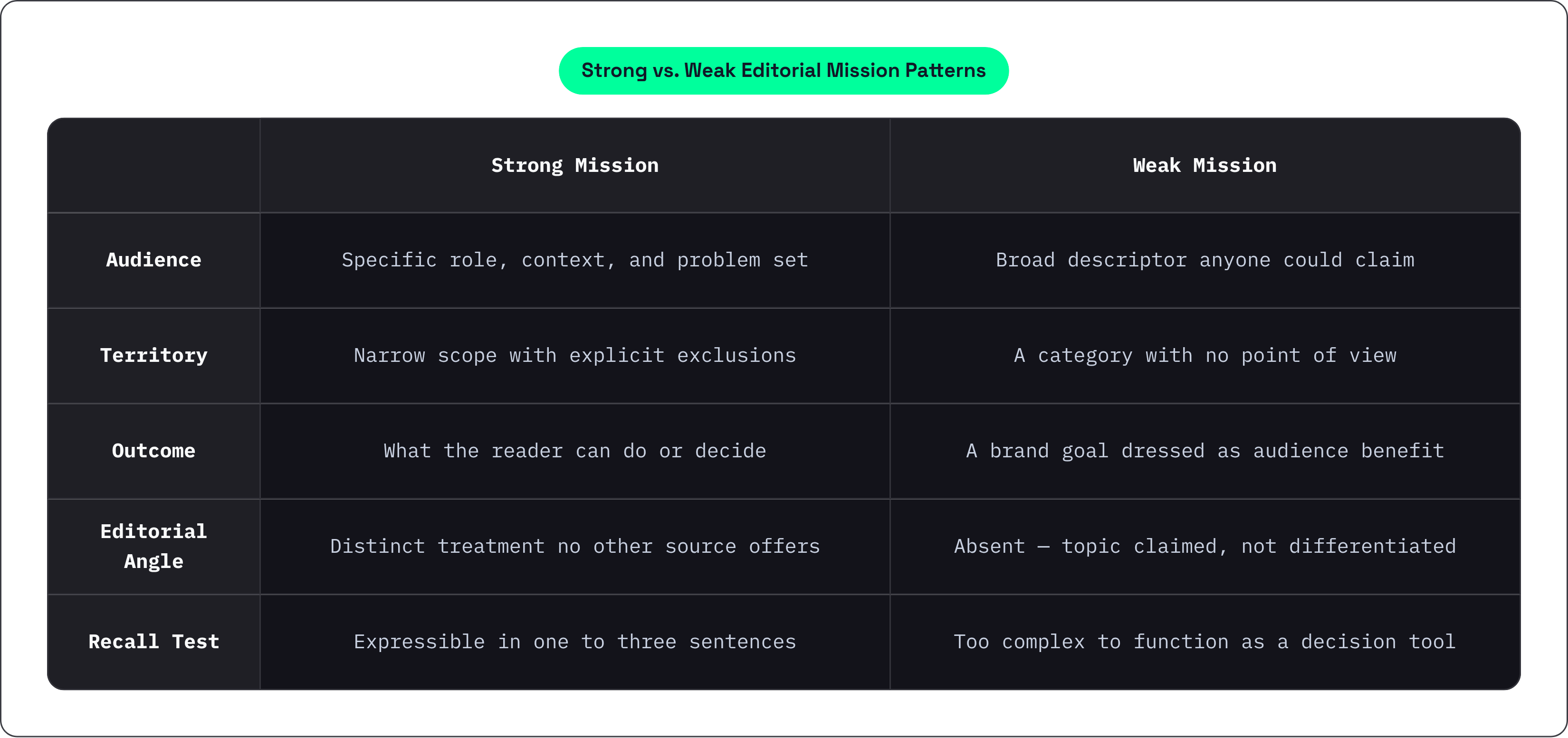
The difference between a strong and a weak mission becomes obvious once you've seen both.
Inc. Magazine's mission states that it is "the voice of the American entrepreneur," serving "the risk-takers, the innovators, and the ultra-driven go-getters that represent the most dynamic force in the American economy." The audience isn't "business readers" or "professionals." It's entrepreneurs, specifically, and the editorial stance is "voice of," not "guide for." That one word, voice, shapes what gets published and what gets killed. It implies advocacy, not utility. A how-to listicle for HR managers doesn't belong. An essay about the psychological cost of a failed venture does.
Bankrate opens in the audience's voice: "You have money questions. Bankrate has answers." Nine words. It signals content type, orients the publication around the reader's life rather than around Bankrate's product set, and creates an immediate test for every piece: does this answer a real money question someone is actually asking? If not, it doesn't belong.
Orbit Media's B2B IT example shows how narrow territory and named outcomes work together: "The best source for info on optical LANs. We show IT buyers how to address tech and business challenges, identify trends, reduce expenses and improve user experiences." Two sentences. Specific audience role, narrow topic territory, four concrete outcomes. Any writer handed that statement could decide in ten seconds whether a proposed story belongs.
ServiceNow's Workflow hub demonstrates something worth noting for B2B programs operating in crowded categories: staking out an editorial angle within a topic, not just claiming the topic itself. The angle is the human relationship to technology at work, not technology for its own sake. That distinction is the difference between a publication and a content archive.
Weak missions share recognizable patterns. The audience is described so broadly it could apply to any publication: "business professionals," "anyone interested in finance." The outcome is stated as a business goal rather than an audience benefit: "grow brand awareness," "drive leads." The territory is a category, not a point of view: "content about marketing," "tips for small businesses." These missions don't fail because they're poorly written. They fail because the foundational decisions weren't actually made before the drafting started.
How to Write One: The Decisions That Have to Be Made Before Drafting Begins
The draft cannot come first. There are four questions that have to be answered with some honesty before a sentence is written.
Who exactly is the audience? Not who might conceivably benefit from the content, but who the publication is specifically for. Role, context, the problem they bring to the page. If the answer could describe a majority of employed adults, it's not specific enough. Keep narrowing until it feels slightly uncomfortable, like you're leaving people out. You are. That's correct.
What territory does the brand have genuine authority or distinctive perspective on? And what adjacent territory should it deliberately leave to others? Restraint in topic scope is not a limitation; it's the mechanism that makes focus possible.
What outcome does the audience need? Not what the brand wants to say, but what the reader should be able to do, decide, or believe after engaging with the content. This is the question most brands skip. Which is why, when you read their mission statements, they sound like they were written for the executive who approved the budget, not for the person who's supposed to show up and read the thing.
What editorial angle makes this publication's treatment different from the next search result? If the honest answer is "nothing yet," that's important information. Address the gap before the mission is written.
Once those four questions have real answers, use the three-part template as a scaffold. Pressure-test the draft against the exclusion test and the recall test. Then involve the team before it's finalized, because a mission that functions as a shared decision-making tool requires shared ownership. One written by a single strategist and handed down tends to be filed. One developed collaboratively tends to get used.
How the Mission Functions as a Day-to-Day Editorial Tool Once It Exists
The primary operational function of the mission is to provide a principled yes or no to content requests that isn't personal, political, or arbitrary. That sounds simple. In practice, it's the thing that saves programs from becoming internal content concierge services, where the editorial team spends its time accommodating requests rather than building a publication.
In editorial planning, pitches get evaluated against the mission before time is invested in development. The question shifts from "is this a good idea?" to "does this serve our stated audience outcome within our stated territory?" Those are different questions, and the second one is harder to argue with.
In writer briefing, the mission gives any writer, staff or freelance, the context they need to make editorial judgment calls independently. A writer who understands the mission doesn't need approval at every step. They can self-correct because they know what the publication is actually trying to do. That's not a small thing. It's the difference between a writing team and a transcription service.
In performance review, when a piece underperforms, the mission provides a diagnostic question that raw traffic data can't answer: did this actually serve the stated audience outcome, or did it drift? That distinction matters because it separates content that failed to reach its audience from content that was never genuinely for that audience in the first place. Those are different problems requiring different responses.
Publishing the mission publicly, placing it visibly on the blog itself, is also a strategic act. It tells first-time visitors immediately whether the publication is for them, before they've invested time in an article. For programs optimizing for subscriber quality rather than raw traffic, that early qualification is worth more than most teams realize.
Teams using AI-assisted content production benefit especially from a written mission, because it supplies the strategic context that generic tools lack by design. Tools like Letterstory embed strategy-first workflows into the writing process, requiring teams to anchor every piece to a defined mission before drafting begins. That makes the mission a structural constraint on how content gets made, not just a document that lives in a shared folder and gets referenced in onboarding decks.
The Difference Between Having a Mission and Acting on It Consistently
Documentation is necessary but not sufficient. According to CMI's 2025 B2B Content Marketing report, only 29% of B2B marketers who say they have a documented content strategy rate it as extremely or very effective. The gap between having a mission and actually using one is where most programs quietly stall.
What separates programs where the mission is genuinely operative from programs where it sits archived comes down to a few unglamorous practices. Editorial meetings open with the mission, not the content calendar. There is a named person with real authority to decline content that doesn't fit; without that authority, the mission becomes advisory rather than binding, and advisory means optional. And published content gets periodically reviewed against the mission to catch drift before it becomes the new default.
The mission also needs an owner who can update it. As the audience's needs shift or the brand's authority expands into new territory, a mission that hasn't been revisited in two years may be more misleading than useful. It should be a stable anchor, not a permanent one. There's a difference.
The real measure of a well-used editorial mission statement isn't whether it exists in the documentation. It's whether a new reader, after engaging with three pieces of content, can accurately characterize who the publication serves. Not after reading the about page. After reading the work. That's the standard worth building toward, and most programs aren't there yet.