Competitor Content Analysis for Market Positioning

Content marketing budgets have grown steadily for five years. Differentiation has gotten worse. More spending is producing more noise, and that is not a paradox once you understand the mechanism.
AI has flooded the zone. A majority of marketers now use AI to assist content creation, according to a 2024 HubSpot survey, and teams using it publish more articles per month than those that don't. Volume keeps climbing. The bar for content that actually earns attention keeps climbing with it, faster than most teams realize or want to admit.
The buyer-side consequence is already measurable. Research from the B2B Institute found that a majority of B2B buyers struggle to meaningfully differentiate between brands in their consideration set, not because they haven't done their homework, but because the brands aren't giving them anything distinctive to hold onto. Publishing faster without a competitive map makes that problem worse. Every undifferentiated piece you ship reinforces the blur.
The process that follows is the corrective.
What a Structured Competitor Content Analysis Actually Produces
This is not a report that lives in a shared folder and gets reviewed once a quarter by someone who wasn't in the room when it was built. The output is a set of prioritized decisions: what to publish, in what format, for which audience stage, and against which competitors.
A rigorous analysis produces four things. A gap map of topics competitors have addressed that you haven't, and topics nobody has addressed well. A keyword opportunity list generated through systematic gap analysis. A buyer journey coverage audit showing which funnel stages are underserved in your content relative to competitors'. And a positioning differentiation brief locating where competitors cluster in their messaging and where genuine whitespace sits.
There is also a budget argument embedded in this. Gap analysis ensures every piece you create serves a demonstrated purpose, not an editorial hunch someone lobbied for in a planning meeting.
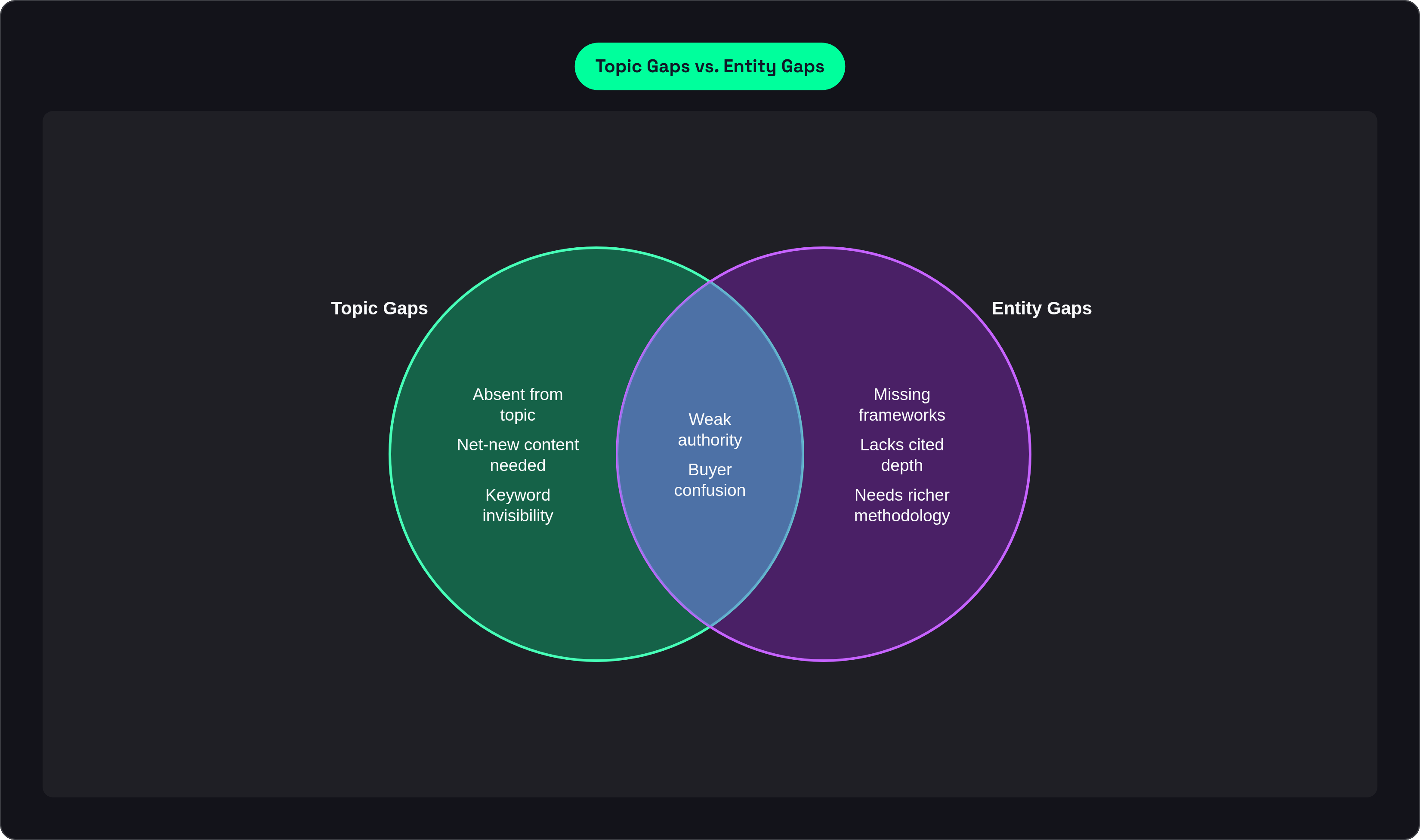
One distinction shapes the whole process, and most teams miss it entirely. There are two types of gaps that require different responses. Topic gaps mean you are entirely absent from conversations your audience is already having. Entity gaps mean you are present on a topic but missing the specific frameworks, methodologies, or conceptual depth that makes content authoritative enough to be cited, shared, or surfaced by search. Net-new content solves the first. Deeper, more rigorous existing content solves the second. Confusing the two is how teams end up publishing redundant pieces on subjects they already cover inadequately, then wondering why nothing moves.
Step One: Mapping Your Competitive Landscape Before Touching a Single Keyword
Most teams skip this and go straight to the keyword tool. The result is an analysis scoped to the wrong competitors, producing intelligence that is technically accurate and strategically useless.
Two types of competitors need to be identified and kept separate. Commercial competitors are companies offering similar products or services to a similar audience. Organic search competitors are websites ranking for your target keywords, and they often diverge substantially from your commercial set. A media publication, a trade association, or a SaaS company in an adjacent category can be a more consequential search competitor than your closest commercial rival.
Group competitors into three tiers. Direct competitors share your industry, audience, and product category. Indirect competitors operate in a different industry but overlap meaningfully in audience and keyword territory. Aspirational competitors occupy a higher market position and run more sophisticated content operations. That third tier is most useful as a quality and format benchmark, not for gap-spotting.
Cap the list at three to five. Analyzing fifteen competitors creates a data dump nobody acts on. Three well-chosen competitors produce more usable intelligence than fifteen because someone actually has to read the output and make decisions with it.
Look for signals of genuine content investment: dedicated content teams, consistent publishing cadences, professional video and visual production. These signals tell you which competitors represent real threats and which are occasional publishers not worth the analytical attention.
Step Two: Running Keyword Gap Analysis to Find Where Competitors Are Winning Search Conversations You're Absent From
Keyword gap analysis identifies high-intent keywords competitors rank for that you don't. These are search conversations happening in your market right now, and you are invisible in them. Quantifying that invisibility is the first step toward addressing it.
The mechanics: load up to four competitors into a keyword gap tool, filter by search volume, keyword difficulty, and relevance to your actual buyer. Not all gaps are worth pursuing. Plenty of high-volume keywords are irrelevant to your audience, and chasing them produces traffic that doesn't convert to anything useful. Prioritize high-intent, lower-competition keywords first, because momentum builds faster there and builds confidence in the process.
Beyond individual keywords, look for topic clusters. A competitor that owns a cluster of related keywords around a specific methodology isn't just winning individual queries; they are building topical authority that compounds over time, making displacement progressively harder the longer you wait.
On tooling: Semrush and Ahrefs are the workhorses here. Semrush's Pro plan runs $139.95 per month, the Guru plan $249.95; Ahrefs starts at $129 per month for the Lite plan. Semrush has an edge on keyword gap features; Ahrefs is stronger on backlink depth. Verify current pricing directly with each vendor before building a budget around these numbers.
Traffic estimates from third-party platforms can diverge from actual Google Analytics data by 30 to 50 percent or more, according to independent analysis by Orbit Media Studios in 2022. Use them for directional pattern recognition. When you present findings to leadership, characterize them as signals, not forecasts.
Step Three: Auditing Content Formats, Topics, and Distribution Channels to Find Structural Gaps
Keyword gaps tell you what conversations you're missing. Format and channel gaps tell you how you're missing them, and the distinction matters more than people expect.
Start with a format audit. Which content types are competitors using that you aren't: how-to guides, comparison articles, video, interactive tools, original research reports, podcasts? Format gaps matter because different formats serve different buyer stages and different cognitive modes. If competitors saturate beginner-level how-to content, the opportunity is in advanced practitioner resources that assume more prior knowledge and treat the reader like a professional. Consideration-stage buyers need comparison guides and case studies; this is a common underinvestment area even in otherwise mature content programs.
Channel mapping follows. Analyze competitor presence across blog, social, video, email, and podcast channels. A competitor that gets the majority of its content reach from organic search is playing a fundamentally different game than one driven by social amplification or email distribution. Knowing which game they're playing tells you where you're actually competing and where you're not competing at all.
For the engagement layer, BuzzSumo's Content Creation plan at $199 per month surfaces which content earns shares and social traction, which often tells a different story than what ranks in search. SimilarWeb provides channel mix and traffic source breakdowns. Brand24 and Brandwatch surface sentiment and mention data, including audience frustrations that show up in comments and forums long before they appear in keyword data.
Survey your own customers. Analyze support tickets. Monitor community forums. Pain points competitors haven't addressed properly surface in those places first, and no competitor analysis tool will find them for you.
The goal here is a topic-and-format matrix: a clear picture of where competitors cluster and where genuine whitespace sits.
Step Four: Evaluating Content Quality and Backlink Authority to Understand Why Competitors Rank, Not Just That They Do
Ranking is not proof of quality. But understanding what earns rankings reveals the standard you need to meet or exceed to displace a competitor.
Content quality assessment should cover several dimensions. Depth and comprehensiveness: do top-ranking competitor pieces thoroughly address sub-topics, include original frameworks, or cite primary research? Recency: are competitors refreshing evergreen content regularly, or letting it age into obsolescence? Entity completeness: are they covering the specific concepts and methodological relationships that signal topical authority, or treating the subject superficially and hoping volume compensates?
Backlink analysis answers a different question. Which competitor pages have accumulated the most high-quality inbound links? These are the authority anchors competitors have often spent years building, quietly, while everyone else focused on publishing cadence. Ahrefs is particularly strong here; its backlink index is deep, and its historical data makes it possible to track how competitor link profiles have evolved over time. Pages with strong, organically earned backlink profiles signal what the broader industry has decided is authoritative.
Before planning net-new content, audit your own existing pages. Sometimes the gap is a declining page that needs significant improvement, not a missing topic. Publishing into a weakening existing content base is a resource allocation error that compounds quietly and is genuinely hard to reverse once the habit is established.
For large-scale operations managing hundreds of pages, MarketMuse applies AI to evaluate content comprehensiveness systematically, identifying topics competitors cover thoroughly and gaps they miss. It is priced for enterprise use; smaller teams will find the manual version of this analysis sufficient and frankly more instructive.
Step Five: Translating Gap Findings Into Deliberate Positioning Decisions
Gap data alone does not produce positioning. The editorial question is which gaps, if filled, would make your brand the recognized authority for a specific audience segment. That takes judgment, and it is where most competitive analyses stall out.
A positioning matrix exercise is useful here. Map competitors across two meaningful axes: audience sophistication versus topic depth, breadth versus specialization, beginner-focus versus practitioner-focus. Locate the whitespace, not just an uncovered topic but an uncovered combination of audience, format, depth, and voice. Positioning built on a single differentiator is fragile; a competitor can replicate one distinction with enough budget and time. Durable positioning stacks multiple dimensions simultaneously, which is why it is harder to copy than it looks.
Buyer journey mapping against your gap findings adds specificity. At the awareness stage, do you have the volume and breadth to enter conversations early? At the consideration stage, are you producing comparison guides, use-case content, and third-party validation? This is where most content programs are thinnest, even mature ones that have been operating for years. At the decision stage, case studies, ROI frameworks, and implementation content are often entirely absent.
The output of this step is a written positioning brief. Not a tagline. A publishing strategy: a clear statement of what your content will be known for, which audience it serves best, which topics it will own, and what tone and format choices signal that authority.
Before finalizing the brief, return to the voice-of-customer findings from step three. If the gaps competitors haven't filled don't map to actual customer pain points, they are not positioning opportunities. They are just unclaimed territory nobody wants. The brief should only include gaps that an identifiable audience segment would genuinely benefit from you filling.
Turning the Positioning Brief Into a Repeatable Content Workflow
The most common failure mode in competitive analysis is completing the audit and then returning to exactly the same publishing habits. It happens constantly, in organizations of every size, and it is almost always because the gap between analysis and execution was never formally closed.
Priority sequencing should follow a clear logic. Address high-volume topic gaps with low competition first; these offer the fastest path to search traction and give the team early wins to point to. Before creating net-new pieces on subjects you've already covered, refresh and deepen existing content to close entity gaps. Build content formats your audience engages with but that you're currently absent from. Close buyer journey gaps at the consideration and decision stages, where conversion rates justify the investment more clearly than awareness content does.
Each piece of content should begin with a brief that states the competitive gap it fills, the audience segment it targets, and the positioning angle that differentiates it from existing content on the topic. This is how the analysis stays connected to execution over time rather than quietly decoupling from it.
AI-assisted workflows can accelerate execution meaningfully. But the competitive intelligence and positioning logic must be built into the brief before generation begins. AI following a rigorous brief produces differentiated content. AI operating without one produces more of the noise that made this analysis necessary in the first place.
Run this analysis quarterly. Competitive landscapes shift. Keyword territory moves. Competitors refresh their strategies. The intelligence degrades, and AI-assisted research has compressed the time required enough that a quarterly cadence is genuinely achievable without expanding the team.
Choosing the Right Tools for Each Stage of the Process
No single platform covers all five steps. The right approach is a purposeful stack built around your team's actual workflow, not around what has the best conference presence or the most impressive demo.
For competitor scoping and keyword gap analysis, Semrush and Ahrefs are the primary options. Semrush has an edge on keyword gap features; Ahrefs is stronger on backlink depth. Many content operations use both. Budget-constrained teams should look at SpyFu, which starts at a lower monthly price point and offers meaningful keyword and competitor data at a lower price point. Coverage is narrower, but for teams earlier in building this practice, it is a credible starting point that won't demand a capital expenditure conversation.
For content engagement and social performance, BuzzSumo surfaces what earns shares and audience engagement, which frequently tells a different story than what ranks. Pairing a search-focused tool with an engagement-focused tool covers more of the analytical picture than either does alone.
For traffic and channel mix benchmarking, SimilarWeb provides competitor traffic estimates and channel breakdowns. For sentiment and mention tracking, Brand24 and Brandwatch surface audience frustrations that don't yet appear in keyword data. For content comprehensiveness scoring at volume, MarketMuse systematizes entity gap analysis in ways manual review cannot sustain across hundreds of pages.
One caveat that applies across everything: third-party traffic estimates are directional signals. Treat them as such, and make sure anyone you share them with understands that too.
The five steps above are operational. Run them consistently, revisit them on a real schedule, and the positioning advantages you build become progressively harder for competitors to replicate, because they've been compounding while the competitors were still deciding whether to start.