Content Strategy for Product-Led Growth Companies
Earn your product mention by making it the natural solution to the problem readers came to solve.
Product-led content puts the product at the center of its narrative, specifically to show how it helps a reader solve a concrete problem. That's the working definition, and it sounds simple until you try to enforce it. The product has to earn its appearance in the piece. It can't be stitched on at the end like a legal disclosure or mentioned reflexively because editorial policy demands it. It has to emerge from the solution itself, which is a much harder editorial standard to meet consistently.
This is where most content teams get it wrong. Generic SEO content can rank without ever touching product value. Product marketing copy gets dressed up as editorial. A blog can mention the product in every post and never once earn the mention. None of that is product-led content; it's product-adjacent noise, and experienced users recognize it instantly.
Think of product integration as a spectrum — like a dial that goes from a whisper to a shout. At the light end, the product appears as one relevant option among several, named without endorsement. In the middle, the product is featured in context: screenshots, step-by-step walkthroughs, a real use case solved in front of the reader. At the heavy end, the content is built entirely around a product capability, tutorials, release walkthroughs, use-case libraries, and the product is the method, not merely the subject.
What makes PLG content distinct is not a format. It's an orientation. That orientation can apply to SEO articles, video, templates, community-generated resources, or standalone free tools. The question at every stage is the same: does this content move someone closer to a meaningful product moment? If the answer is no, it has no business being on the roadmap.
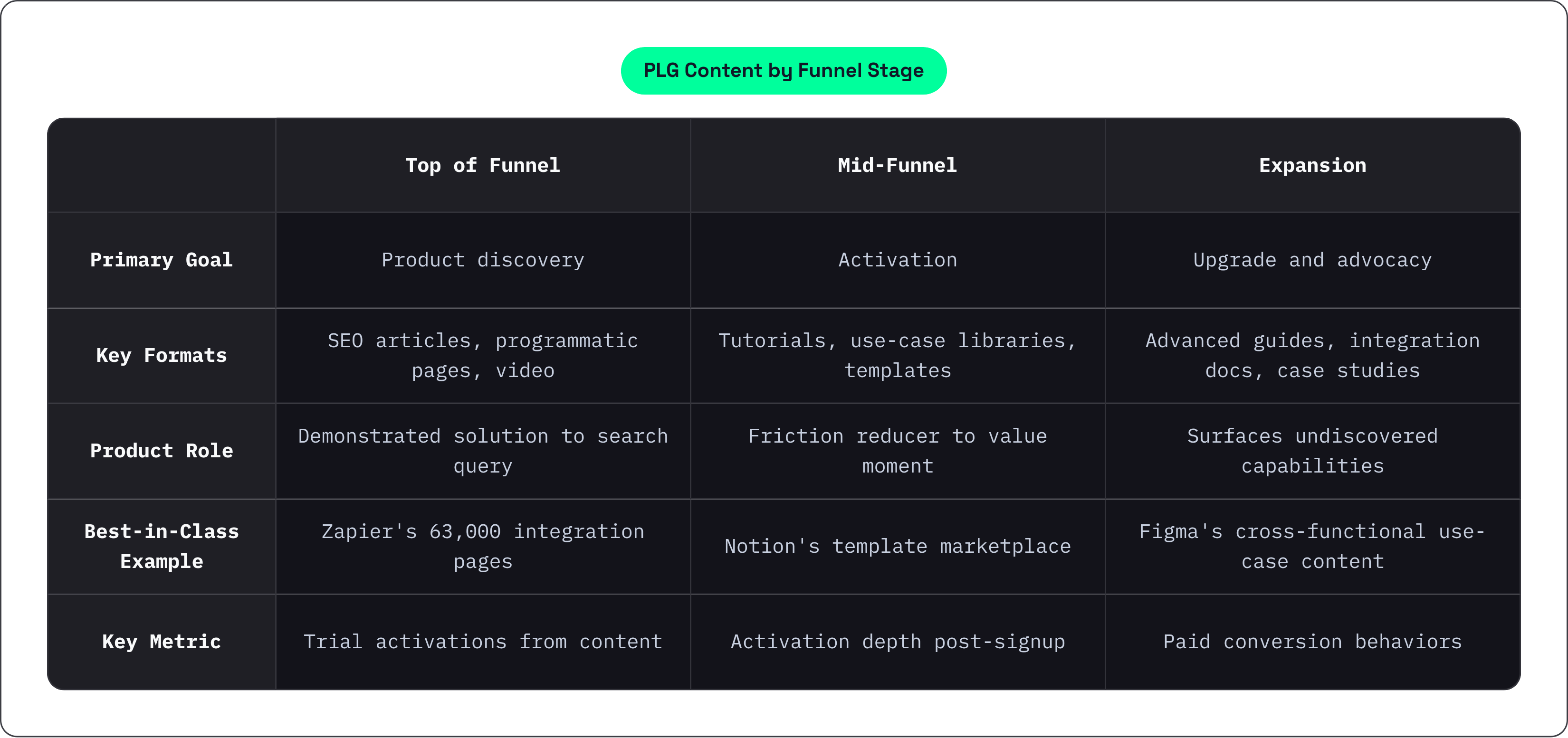
This matters because user intent and relationship to the product change dramatically across the funnel. A reader encountering the product for the first time through an organic search result needs something entirely different from a user who signed up last week and hasn't yet discovered the feature that would make them stay. One content strategy cannot serve both. The framework has to be built stage by stage.
How to score topics by business potential before committing to a content calendar
Standard SEO prioritization, search volume multiplied by some inverse of keyword difficulty, optimizes for traffic. Traffic is not the goal. Product discovery is. Those two objectives require a different scoring methodology before any content goes into production.
Ahrefs built a business-potential scorecard to address exactly this gap. After filtering for topics with legitimate traffic potential and audience relevance, each topic gets scored on how naturally and effectively the product can be integrated into the content itself. Topics scoring in the top two tiers make the calendar. Topics that score lower stay off it, regardless of search volume. The underlying logic is that a topic with moderate traffic and high product-integration potential will outperform a high-traffic topic where the product can't appear without feeling like an intrusion. I've seen that play out enough times that I now treat it as a given rather than a hypothesis.
Writers and editors can apply a two-axis version of this framework before a brief is ever written. First axis: does the person searching for this topic have a problem the product directly solves? Second axis: can the product appear as a natural, demonstrated solution rather than a parenthetical mention? A useful litmus test for that second axis is concrete and blunt. If the product can't appear in a screenshot or a worked example within the piece, the topic scores low, regardless of what the keyword tool says.
This kind of evaluation has to happen before content production starts, not after. Teams that build their calendars in reverse, starting with production capacity and filling it with whatever ranks, consistently produce content that performs in analytics and does nothing for activation. I've watched this happen at companies with otherwise smart growth functions. The calendar fills up, the traffic numbers look healthy, and six months later someone is asking why signups aren't moving.
Top-of-funnel content built around discovery, not just awareness
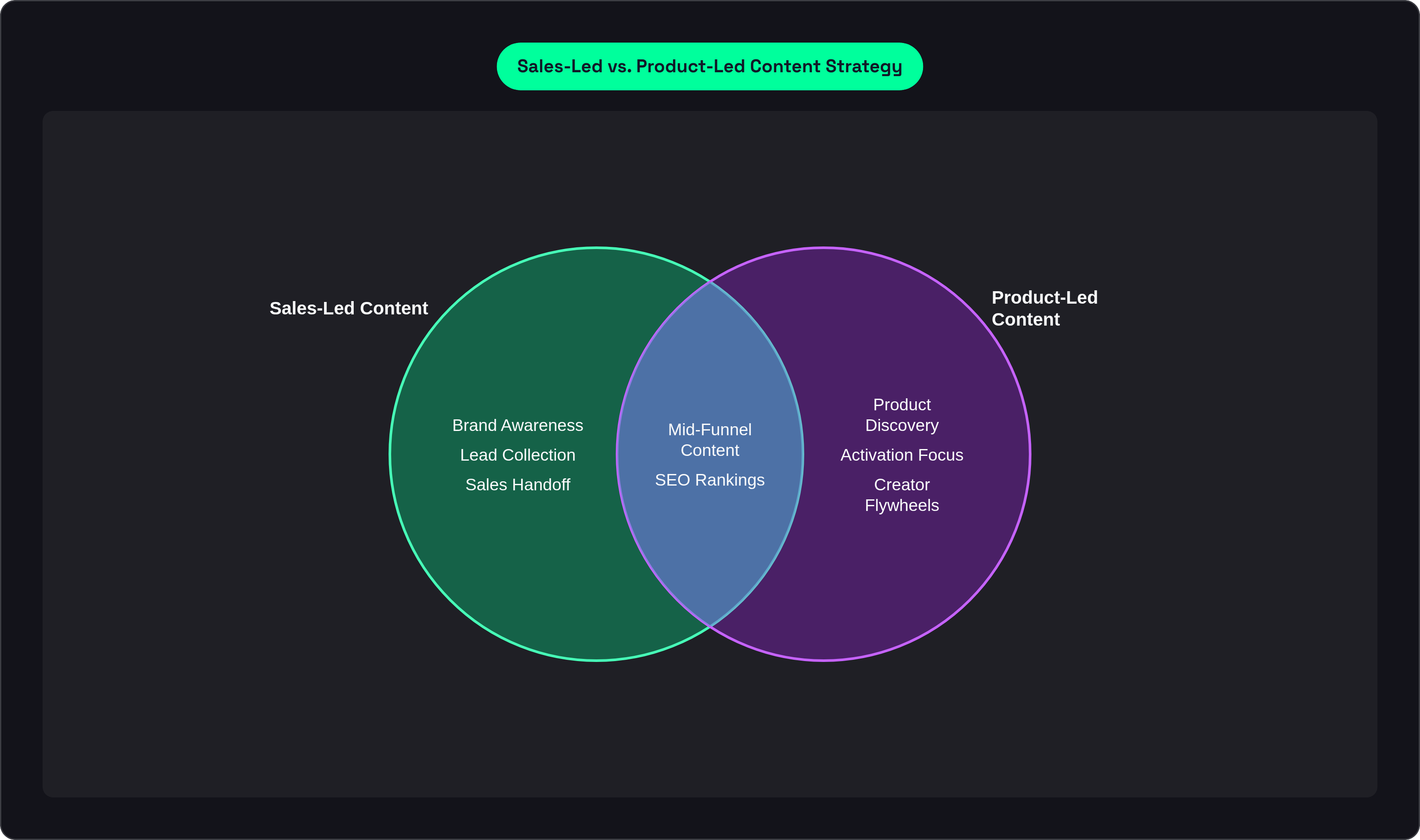
In a sales-led model, top-of-funnel content builds brand awareness and collects contact information so a sales team can follow up. In a PLG model, that is not enough. ToFu content must drive product discovery, meaning users should encounter the product as a demonstrated solution, not merely as a brand name they've now encountered.
The primary format here is product-led SEO content: editorial pieces that address real search queries and weave in product use as the answer. Ahrefs is the benchmark for this. Their content explains how to perform SEO-related tasks and uses Ahrefs screenshots throughout, not selectively, but consistently, because the product is the method. The reader doesn't feel sold to because they aren't being sold to. They're being shown how to do the thing they came to learn, and the tool doing it is Ahrefs. There's also something worth noting about how Ahrefs gets their writers to that level: new marketing hires complete the company's own Academy courses and rotate through customer support for at least three months before joining the content team. That onboarding structure is the mechanism that ensures every writer can demonstrate the product from lived experience, and lived experience is a non-negotiable prerequisite for this kind of content.
Zapier's editorial blog operates on the same principle. The site generates close to nine million monthly organic visits, built almost entirely on task-specific how-to content that naturally surfaces Zapier workflows. The product is the answer to the question the reader typed into Google.
Channel mix at the top of the funnel follows logically from this. Organic search is primary because intent is pre-established when someone searches. YouTube and social serve as amplification layers where product storytelling can be shown rather than described. Video lets you walk someone through a product moment in a way a paragraph can't fully replicate — it's the difference between reading a recipe and watching a chef cook. A meaningful distinction worth noting: that difference in format changes what's possible.
Generic thought-leadership content, the kind that stakes out positions on industry trends without ever getting specific, can rank and never produce a single meaningful product interaction. It inflates traffic metrics while contributing nothing to activation. It's common, it's insidious, and it's a waste of editorial budget.
Programmatic SEO as a scalable product-discovery engine
Programmatic SEO is the practice of generating large numbers of templated pages, each designed to match the search intent of users who have a specific, product-relevant problem. When executed well, it is one of the highest-leverage content investments a PLG company can make.
Zapier's execution is the canonical case study, and it's worth understanding the sequence of how it happened. Founder Wade Foster initially built standard top-of-funnel blog content, then recognized it wasn't intercepting users who were actively looking for a solution to a specific integration problem. So Zapier built close to 63,000 templated pages following a consistent URL architecture, each targeting a specific integration search query. The result, per Ahrefs data: more than 280,000 organic visits per month from high-intent searchers. Each page shows the specific "zaps" available for the apps in the query. The product is literally the content.
It works so well for PLG because the users landing on these pages already have the problem the product solves. Intent and product value are pre-aligned before the user even arrives. There's no warm-up required, no trust-building preamble. The reader came looking for a solution to "connect Slack and Google Sheets automatically," and the page shows them exactly how to do it with Zapier. That is product discovery at scale.
The prerequisites matter, though, and this is where teams sometimes underestimate the commitment. Programmatic SEO requires a product with clearly definable use cases that can be systematically templated. Integration tools, design platforms, and automation software lend themselves to this naturally. Less modular products require more creativity in the template architecture and more rigor in quality control. pSEO also requires real technical infrastructure investment, not just editorial effort. It is a content system, and systems require engineering and ongoing maintenance alongside editorial judgment. Teams that treat it as a content shortcut will end up with thousands of pages that get crawled and ignored.
Mid-funnel content that drives activation, not just consideration
Activation has no clean equivalent in sales-led models, which is one reason PLG companies struggle to build content strategy for it. In a sales-led funnel, mid-funnel content drives consideration and moves prospects toward a sales conversation. In PLG, the mid-funnel is about getting users to a specific product moment: the point at which they've extracted enough value that continued use becomes self-reinforcing. Content's job here is to reduce every possible point of friction between signup and that moment.
The formats that serve activation share a common structure. In-depth tutorials with product screenshots show exactly how to accomplish a specific outcome. Use-case libraries organized by job-to-be-done, not by feature, let users navigate to the answer that's relevant to them rather than reading documentation written for product managers. Template libraries let users start from a working example instead of a blank state, which removes the single biggest cause of early churn: the paralysis of not knowing where to begin. A blank canvas is the enemy of activation — nobody ever wrote a novel by staring at an empty page.
Notion's template marketplace is the model here. Users build and share templates publicly; new users discover them through search and social, sign up to use them, and enter the product with immediate value already in hand. User-generated templates function as SEO content, which collapses acquisition and activation into a single asset. That's a structurally efficient outcome that most content teams haven't figured out how to engineer deliberately.
Figma's community operates on a similar logic. Designers share templates, wireframes, plugins, and design systems. Prospective users sign up to access those resources. Existing users stay engaged beyond their own projects because the community gives them a reason to return. The content drives activation and retention simultaneously.
The organizing principle for mid-funnel content is outcomes, not features. Users who just signed up don't care what the product can do in the abstract. They care about accomplishing the specific thing they came to accomplish. Content built around that intent converts. Content built around feature showcases falls flat.
How free tools and educational content create product-adjacent entry points
Free tools serve a dual function that makes them one of the most strategically efficient content investments available to PLG companies. They deliver standalone value, which builds genuine trust, and they introduce the product's logic and vocabulary to users who haven't yet committed to a signup. Both of those outcomes compound.
HubSpot's execution is the clearest example at scale. Their resource hub includes free tools, templates, and educational materials that marketers use entirely independent of any purchasing intent. HubSpot Academy extends this further, offering courses and certifications across marketing, sales, and service topics at no cost. Users who complete those certifications aren't just educated about marketing concepts; they're fluent in HubSpot's framework and vocabulary before they ever evaluate the paid product. That fluency dramatically lowers the activation barrier when they do sign up, because the product's worldview already makes sense to them. They've essentially been onboarded before onboarding begins.
For PLG companies specifically, the design principle for free tools is precise: the tool should solve a version of the exact problem the core product solves, at a lower level of complexity. Users who hit the ceiling of the free tool are pre-qualified for the paid product. They already know the problem is real, they've already experienced the solution approach, and they've already decided they trust the company enough to use its tool. That's a remarkably short distance to conversion.
Content teams should treat free tools as content assets with SEO value, not as product features that live in the product section of the website. They rank. They earn backlinks organically because they're genuinely useful. They drive qualified signups with higher activation rates than cold organic traffic. That combination of outcomes is rare, and it's available to any PLG company willing to invest in building the tool rather than just writing about the problem it solves.
The creator and community flywheel that turns users into a distribution channel
The flywheel works like this: users become creators, creators become acquisition channels, new users enter the product and repeat the cycle. Once that loop is spinning, it generates compounding returns on an investment that, at its inception, cost very little.
Notion is the clearest documented example of what this looks like when it scales. Power users like Thomas Frank and Marie Poulin built substantial YouTube audiences teaching Notion workflows, generating organic product education at a scale no internal content team could replicate on budget. Crucially, Notion's creator program started with grants, swag, and early product access rather than large sponsorship checks. Paid creator investment came only after organic signal was already strong. You don't build this flywheel by paying for it upfront; you find the users who are already spinning it and then remove friction for them.
Olivia Nottebohm, in her time as CRO at Notion, described it plainly: community drives rapid adoption for you if you want your product-led company to scale. Ben Lang, who led Notion's community work, observed the compounding economic logic: as more people watch videos over time, the cost per acquisition declines. Evergreen content continues to drive users toward the product indefinitely, and that's a metric most content teams don't track but probably should.
Figma's community operates on a related but distinct dynamic. Designers share work in the Figma Community as an act of professional self-promotion. Contributing is an incentive, not an obligation. The byproduct is a free library of high-quality resources that attracts prospective users and keeps existing ones engaged in ways the product's native feature set alone couldn't sustain.
What separates PLG creator programs from standard influencer marketing is how they're measured. Raw signup volume is an insufficient metric; it can rise while paid conversion quietly falls. The behaviors that matter are correlated with paid conversion: a second invited user, a second file or document created within a defined window, any action that signals the user has moved from curious to committed. The internal content team's role in this model evolves accordingly. The job expands from producing content to seeding, enabling, and amplifying creator and community content, because the multiplier on that work exceeds anything the internal team can produce alone.
Expansion content that turns active users into advocates and upgrades
In PLG, retention and expansion are content problems as much as they are product problems. Users who don't discover advanced capabilities don't upgrade. Users who don't understand how the product fits into their broader workflow don't invite teammates. The content strategy for expansion has to be built around surfacing value that users haven't found yet, not reinforcing value they already know about.
Figma's viral loop illustrates this at the revenue level. The product spreads naturally from design teams to developers, marketers, and executives because Figma's collaboration workflow involves non-designers organically. Content that explains cross-functional use cases accelerates that spread by making the value legible to people who weren't the original buyer. Figma's net dollar retention rate of 136%, reported alongside over a billion dollars in annual revenue growing at 41% year-over-year, is evidence that expansion within existing accounts is a primary growth lever.
The content formats that serve expansion share an intent: they assume the user knows the basics and wants to go further. Advanced use-case tutorials surfaced to users who have completed basic activation. Integration guides that show how the product connects to other tools in the user's stack. Case studies and customer stories framed around outcomes at scale, not onboarding steps. These formats communicate that more value is available and show users specifically how to reach it.
Advocacy is the far end of the expansion content spectrum, and it requires a design decision more than a content decision: make sharing a natural workflow step rather than a deliberate marketing act. Notion's one-click template duplication is the clearest example. Users share templates because sharing is part of how they use the product, not because they've been asked to promote it. That distinction matters because advocacy that feels effortful doesn't scale. Advocacy that happens as a byproduct of normal product use compounds without anyone having to manage it.
Canva's freemium model demonstrates the upgrade conversion side of the same equation. Premium templates and brand kit features sit behind the paywall, and users encounter that boundary at the exact moment they're most motivated to cross it. Content that demonstrates those premium use cases in detail functions as the conversion mechanism. The user already understands the value because they've seen it shown, not just described. The only remaining question is whether the upgrade is worth the cost, and at that moment of high intent, the answer is usually yes.
How to build the internal process that makes PLG content sustainable
The organizational prerequisite is product fluency. Writers who cannot demonstrate the product in context cannot produce product-led content, regardless of their editorial skill. This is a hiring and onboarding problem before it is anything else.
Ahrefs' approach is the model worth replicating here. Content team members are required to complete the product's own Academy courses and rotate through customer support before they begin writing. That rotation isn't courtesy professional development. Direct customer interaction and hands-on product use are the inputs that make it possible to write about the product from the inside rather than from the outside. A writer who has spent time answering customer questions knows which problems are genuinely confusing, which features are chronically underused, and where users reliably drop off. That knowledge is irreplaceable. You cannot approximate it by reading the product documentation.
The strategy-first workflow follows from there. Topic scoring and business-potential evaluation happen before briefs are written. The calendar is built around product fit. Content volume is a downstream constraint, not an upstream driver. Teams that invert this, filling a production calendar first and hoping for strategic coherence later, consistently produce content that is editorially competent and strategically inert.
Speed is a real constraint in PLG environments. Products move fast. Feature releases, activation improvements, and use-case expansions happen on a cadence that a traditional content operation, built around long production cycles, cannot match. AI-assisted content production paired with rigorous editorial oversight can resolve this tension when the workflow is structured correctly. Product accuracy, in-context screenshots, and on-brand voice are maintainable at speed, but only when the right context and constraints are built into the production process from the start. That's a systems problem, and it has a systems solution.
Measurement is where PLG content strategy either proves itself or quietly fails. Standard content KPIs (pageviews, time on page, organic rankings) measure what happened before product interaction. PLG metrics measure what happened after. Track signups and trial activations from content, not just traffic. Monitor activation depth: do users who arrive via content complete the key product actions, or do they read and leave? For creator and community content, watch paid conversion behaviors rather than raw signup volume, because the latter can look healthy while the former is deteriorating.
The compounding logic, when the system is working, becomes self-reinforcing. PLG content that drives product use generates user behavior, user behavior generates product signal, product signal informs better content, and better content drives more product use. The companies that have built this flywheel — Ahrefs, Zapier, Notion, Figma, HubSpot — didn't get there by producing more content. They got there by building a system where every content decision was evaluated against a single question: does this move someone closer to a meaningful product moment? That question, applied consistently and without exception, is the entire strategy.